
Imagine not feeling the sun on your skin for most of the year. For residents of Rjukan, a tiny Norwegian town nestled deep in a valley, that’s just life.
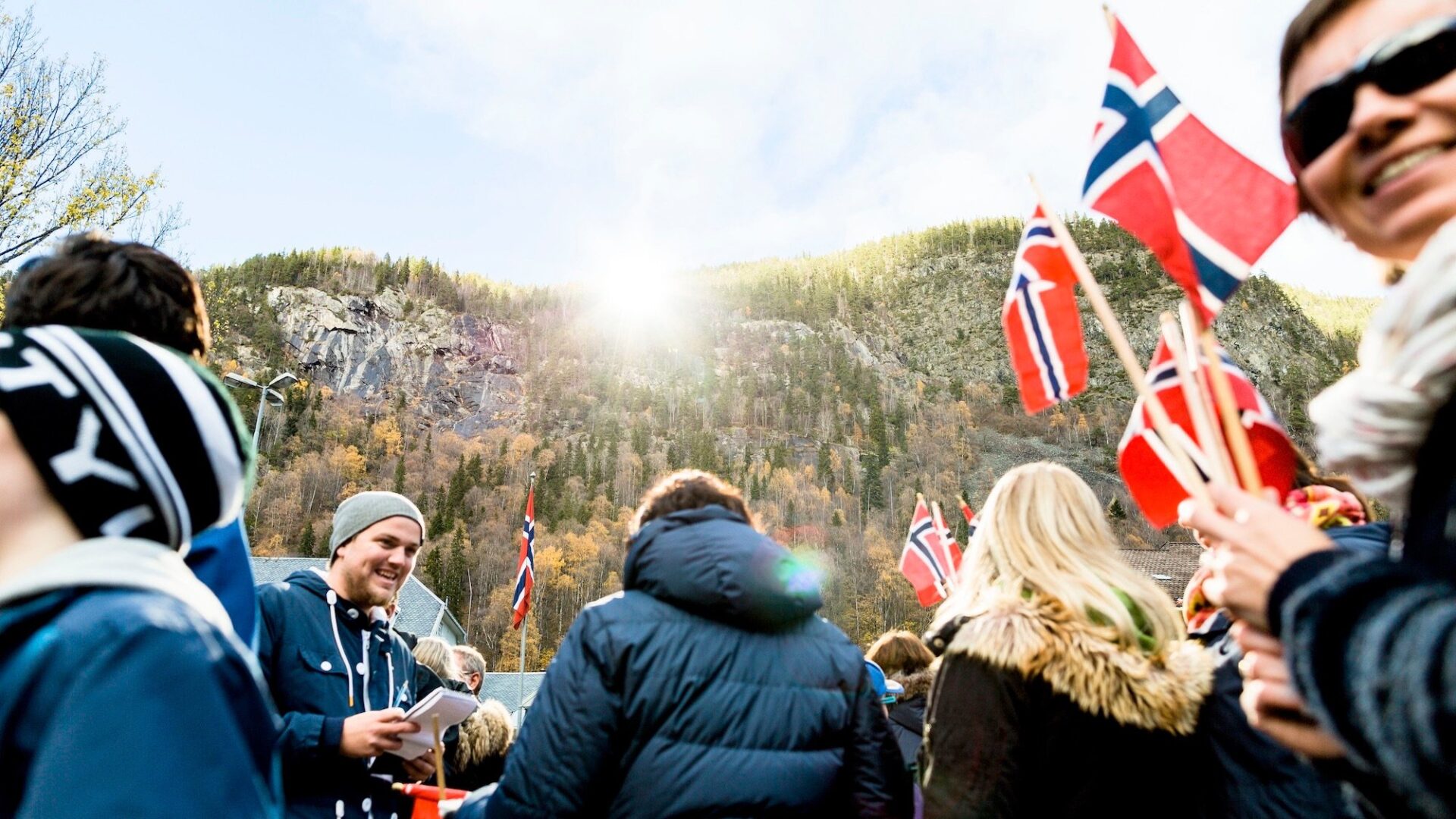
Or, it was, until a local artist set up giant mirrors to reflect some sun to the town’s square. Residents and visitors alike can walk through reflected sunlight in a town that otherwise only sees ambient light between September and March.
Rjukan, a three-hour drive west from Oslo, is home to around 3,000 people. It’s been a major tourism destination since the 1800s, mostly thanks to some nearby waterfalls. These days it’s arguably better known for the mirror array. In October 2013, when sunlight first hit the town square, the event was covered by the BBC, NPR, National Geographic, and the Associated Press, among others, creating international interest in the small town that persists to this day.
Sam Eyde, the town’s founder, proposed such a mirror way back in 1913 according to an article on Visit Norway, an official tourism website. His idea wasn’t fulfilled for a century, though by 1928 there was a gondola residents could take to the top of the hill in order to visit the sun.
The three mirrors, originally set up by local artist Martin Andersen, are each a little bigger than a parking spot—17 square meters or 183 square feet. A computerized system turns the large mirrors so that a patch of the town square roughly the size of three tennis courts is bathed in sunlight throughout the day.
The huge sun mirrors (“Solspeilet”) that is set up on the hillside above Rjukan, to reflect sunlight down on the town square, is seen during its officially opening, on October 30, 2013.Image: Krister SORBO / AFP / Getty Images KRISTER SORBO
It’s not an easy system to maintain. The mirrors sit 450 meters, or 1,476 feet, above the town. Originally there was no power line to the top of the mountain, which is why the array depended on solar panels and a backup diesel generator. The mirror broke down in 2022, and wasn’t fixed until 2023.
The idea of the mirrors wasn’t universally popular. More than 1,000 people signed a petition against the initial construction, a huge number for the tiny town. Opposition died down, and these days the mirror is popular in no small part because of the tourism boost.
The 2023 repairs, in which the entire system was essentially replaced, cost 3 million kroner, a little over $310,000—a big expense for a tiny town. There’s no road to the array, so crews hiked the new components up in backpacks.
People cheer during an inauguration of the huge sun mirrors (“Solspeilet”) set up on the hillside above Rjukan.Image: AFP PHOTO / KRISTER SOERBOE via Getty Images KRISTER SORBO
The new mirror has a number of new features. A power line gives the mirrors a stable source of power, and an internet-based system gives the municipality the ability to control the mirrors remotely. They can even direct the light to other parts of the town, not just the market square—the skating rink, for example.
It’s a remarkable story. A small town, armed with mirrors, math, and a few computers, managed to bring light to a valley that otherwise wouldn’t see sunlight for half the year. I’d love to visit someday.
The post The Norwegian town that built mirrors to experience the sun appeared first on Popular Science.
