
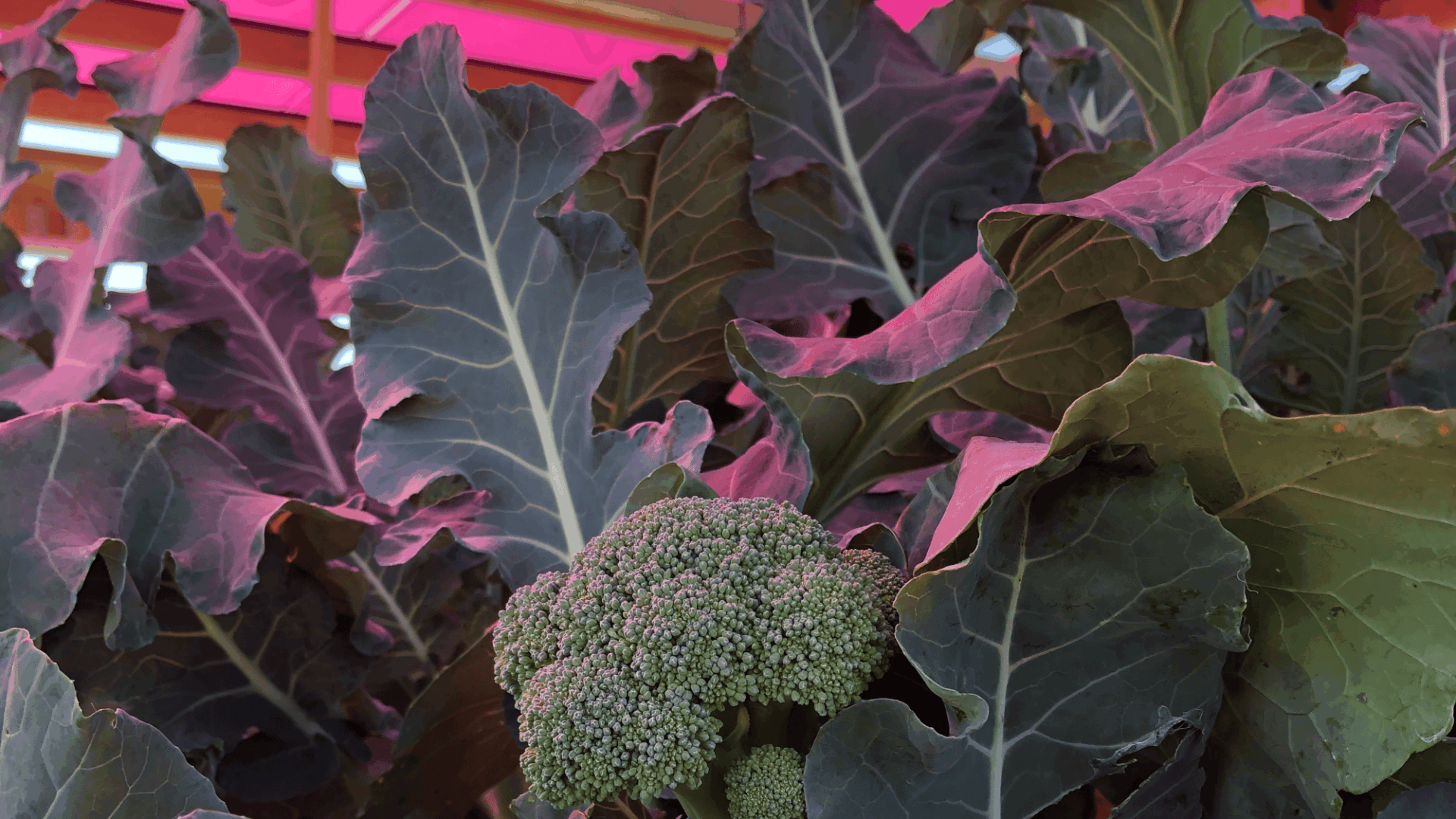
The key to helping a nutritious green vegetable grow more efficiently may be the color pink. Magenta-colored solar panels help the broccoli absorb sunlight more efficiently, according to a study published today in the journal Cell Reports Physical Science.
“The basic concept is quite straightforward,” Silvia Ma Lu, a study co-author and engineer at Mälardalen University in Västerås, Sweden, said in a statement. “The solar panels use part of the incoming sunlight to generate renewable electricity while allowing part of the light to pass through to the crops growing underneath.
The field of agrivoltaics, or using land for both farming and solar power generation, is growing partially due to its versatility. Conventional solar panels allow farmers to produce renewable electricity in fields where ample space is already available. The panels also protect plants from exposure to too much sunlight, and help shield them from hail or heavy rainfall. However, conventional dark-blue solar panels are typically opaque, and can create too much shade. This extra shade reduces some crops’ yields, and semi-transparent and colored panels can help mitigate this crop loss.
“There is no single agrivoltaic design that will work optimally everywhere,” said Ma Lu. “More research is needed to understand how different crops respond to different system configurations and climatic conditions and to design systems that balance agricultural production with renewable electricity generation.”
To investigate, the team first had to choose a vegetable. They selected broccoli, a popular (debateable) veggie full of fiber, Vitamin C, Vitamin K, and more. Broccoli is also well suited to the climate of the experimental site on a farm in Sweden. The researchers built two 65-foot by 65-foot (20-meter by 20-meter) systems made from semi-transparent, magenta-colored solar panels with different levels of transparency. This transparency allowed varying amounts of sunlight to reach the plants being cultivated beneath them. In a third plot of land, broccoli plants were fully exposed to the sun.
EMBED GRAPHICAL ABSTRACT
During the 2024 growing season, the team compared the broccoli in each plot. They checked environmental conditions including air temperature, relative humidity, and soil moisture in addition to crop yield, nutrient composition, and how well the plants performed photosynthesis.
The crops grown with the magenta panels showed a 4.5-fold increase in how efficiently they used sunlight. The broccoli grown here ultimately grew as large as traditional broccoli flowers. However, it took the plants 25 days longer to mature. Still, the solar panels offer a potential tool for farmers to harvest renewable energy while sustaining crop yields at the same time.
“One of the most interesting findings was how similarly the broccoli performed under the two solar panel systems despite their different transparency levels,” says Ma Lu.
Lu noted that the solar panels with a greater density of photovoltaic cells (the materials in solar panels that convert sunlight into electricity) can produce more electricity, and that these findings should be tested with other growing seasons, crops, and solar panel set-ups.
Additional research at larger scales could help develop technology for wider use in agriculture. Electricity generated from crops could potentially power irrigation, machinery, cooling and storage systems, or other farm operations. The electricity could also be supplied to the grid, lowering farmers’ electricity bills and providing an additional source of income.
The team has already begun to test the magenta panels further, as well as red and blue ones. They’ve tested them in controlled lab settings, without interference from light that isn’t filtered through the panels.
“Configurations similar to our prototype may currently be suitable for smaller-scale applications, such as community gardens, or for integration into greenhouse roofs rather than immediate deployment over large agricultural areas,” said Ma Lu.
The post Pink light helps broccoli grow appeared first on Popular Science.
Pink light helps broccoli grow
