
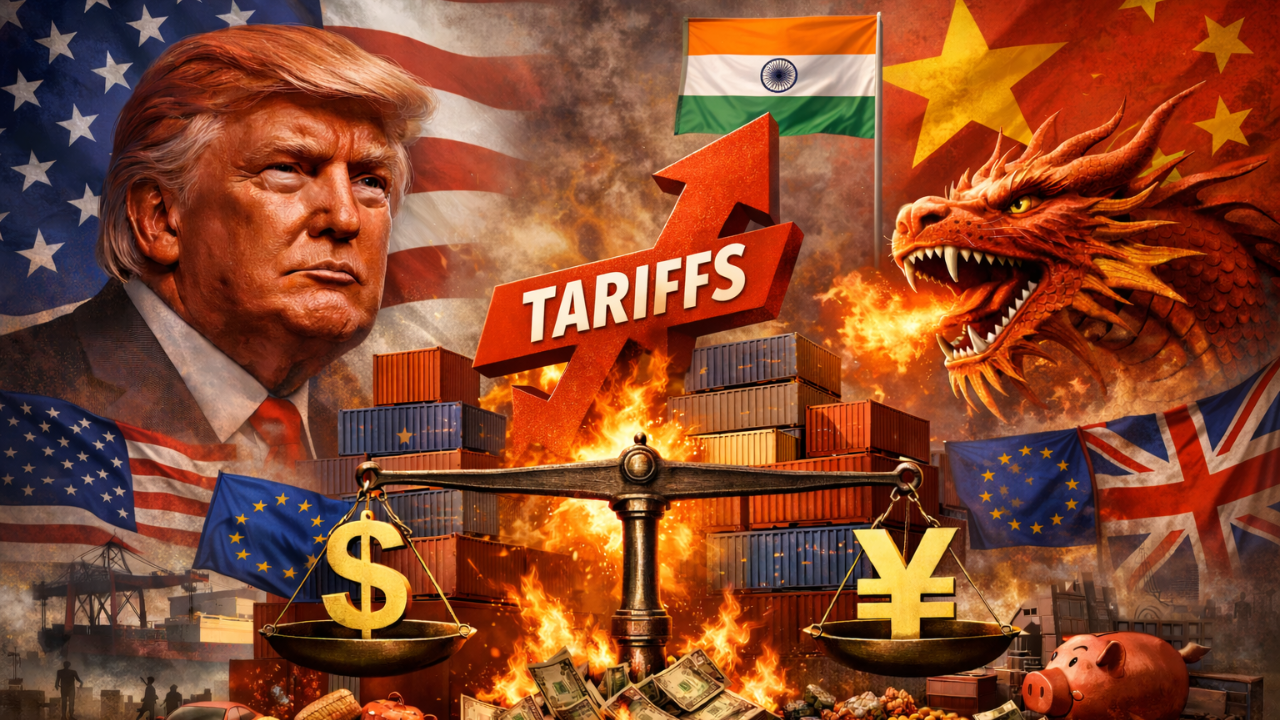
In recent weeks, US President Donald Trump has returned to a familiar script – striking trade deals that appear limited on paper but carry political weight at home. Agreements with India and Argentina have offered selective tariff relief in exchange for wider access for American companies to domestic markets. Technically modest, politically volatile.
In India, farmers’ unions called the India-US (interim) deal a “total surrender”, fearing cheaper imports would deepen existing pressures on local producers. Critics warned of India becoming a dumping ground. However, Union Commerce and Industry Minister Piyush Goyal stressed that sensitive sectors remain protected.
“I want to clarify that India’s interests and the interests of Indian farmers have been fully protected in the US-India trade deal. Most of the products of Indian farmers, our dairy, poultry, rice, wheat, soybean, and maize, banana, strawberry, cherry, orange, vegetables, ethanol, tobacco, meat, pulses, millets, bajra, ragi – almost 90–95% of the produce of farmers is outside the US trade deal,” Goyal said at the ET NOW Global Business Summit (GBS) 2026. Notably, the “framework agreement is being made”, and the fine print of the deal is still not finalised.
This unease is not uniquely Indian. When the European Union reached its own agreement with Washington, the backlash was just as sharp. France’s former prime minister described it as an act of “submission”, capturing a discomfort many governments feel but rarely say aloud — that negotiating with the world’s largest economy seldom feels equal.
Across nations, the pattern is familiar. Trade agreements sold as pragmatism are increasingly judged as tests of sovereignty and political nerve.
The fine print may talk tariffs, but the real argument is about power — and who ends up paying for its exercise.
How “Liberation Day” turned into a year-long economic experiment that nobody asked for…
April 2, 2025. Rose Garden. Donald Trump declares “Liberation Day” and announces he’s slapping tariffs on basically everything coming into the United States. Not in six months. Not after consultations. Starting in three days.
Here’s what he did: A flat 10% tax on all imports beginning April 5. Then, just four days later, additional country-specific tariffs kicked in—ranging from 11% all the way up to 50%. All under emergency powers that were supposed to be for actual emergencies.
Wall Street didn’t wait to see if he was serious, which he is (isn’t) more often than not, until his mood gets better. Within days, the stock market crashed. Trillions in wealth gone. Jerome Powell at the Federal Reserve tried to stay diplomatic but couldn’t hide his concern: these tariffs were “significantly larger than expected.”
The China escalation…
The fight with China turned into something close to economic warfare. It started quietly with a 10% tariff on Chinese goods, officially about stopping fentanyl smuggling. After Liberation Day, all pretenses of restraint vanished. The US went to 145% on Chinese imports. China fired back with 125% on American goods.
You want to know when everyone realised this was real? When ships started arriving half-empty in May. Retailers had done the math and simply stopped ordering. The 145% tariff made importing impossible. Dock workers in Los Angeles and Long Beach reported cargo volumes cut in half almost overnight.
That’s when both sides blinked.
On May 12, Washington and Beijing agreed to hit pause—cutting tariffs back to 10% each for 90 days. They kept extending that truce, and by November, they’d settled on something more permanent: US tariffs at 3% and Chinese tariffs at 10%, running through November 2026.
Tariff blow to Canada and Mexico
Canada and Mexico got hit on February 1—weeks before Liberation Day even happened. Trump’s justification? They weren’t doing enough to stop drugs and illegal immigration.
The tariffs: 25% on most goods, 10% on Canadian energy.
Justin Trudeau threatened CA$155 billion in retaliation. Mexico’s President Claudia Sheinbaum made it clear they’d fight back. The tariffs went live on March 4.
Then something interesting happened. Two days later, the administration carved out a huge exemption: anything meeting the rules of the existing USMCA trade deal got zero tariffs. Only non-compliant stuff faced the full hit—which later climbed to 35% for Canada.
End result? More than 85% of US-Canada trade continued untouched. The political theatre was loud. The actual economic impact was weirdly selective.
India… the quiet deal
India’s story is different because it played out mostly behind closed doors.
When Liberation Day hit, India got slammed with a 50% tariff. Trump called it “reciprocal” because India has its own protectionist barriers. Fair point, maybe. But 50% was designed to hurt.
Narendra Modi’s government wasn’t happy. They warned publicly about consequences. Privately, they made clear to American tech companies, pharma exporters, and agricultural producers that retaliation was coming—and it would target their Indian revenue.
Neither side wanted a full rupture. India needs American capital and technology. The US needs India as the alternative to China in global supply chains.
Negotiations dragged through June and July. The breakthrough came in August. India agreed to cut tariffs on motorcycles, medical devices, and certain agricultural products. They promised better customs procedures and movement on intellectual property protection.
On February 2, Trump announced on social media that the trade deal with India was finalised and added a rider on Russian oil. Following this, the US dropped India’s rate from 50% to 18%. Prime Minister Modi, while welcoming the deal, didn’t comment on the Russian oil condition imposed by Trump.
When Team Trump went after entire industries…
Country tariffs were only half the story. Trump also weaponised Section 232—the law that lets presidents impose tariffs for “national security” reasons.
June 4, 2025: Steel and aluminum tariffs doubled from 25% to 50%. Later, household appliances got swept in.
April 3, 2025: Cars and auto parts hit with 25%.
The auto industry got destroyed:
General Motors: $4–5 billion in tariff costs for the year
Volkswagen: €1.3 billion in losses in just six months
Toyota: Cut profit forecast by ¥1.4 trillion ($9.5 billion)
Eventually, they cut deals. The EU settled at 15%. Japan took 15% and promised $550 billion in US investments (good luck tracking if that actually happens). South Korea accepted 15–25% and pledged $350 billion.
When Trump started feeling heat of his Tariff…
By mid-summer last year, the political pressure was undeniable. The stock market had recovered, but consumers were getting hammered. Business groups were screaming. Even Republican senators started asking questions.
Critics started using a phrase: “Trump Always Chickens Out.” The pattern was clear—threaten massive tariffs, then negotiate them down.
By year’s end:
UK: 10% tariff
Switzerland: dropped from 39% to 15%
Multiple deals across Asia and Latin America
Then came the agriculture exemption. On November 14, Trump admitted the obvious: America doesn’t grow enough coffee, tea, cocoa, or tropical fruits to meet demand. So he exempted them.
By December 2025, half of all imports were exempt from the emergency tariffs. Many still faced the sector-specific charges, but the reciprocal tariff regime was already full of holes.
So Who Actually Won These Deals?
Here’s where it gets interesting. The Economist did an analysis of every deal Trump signed, and the results weren’t what you’d expect.
The Biggest Losers: Cambodia and Malaysia
Small countries with no leverage got crushed. Both rushed to sign deals. In exchange for tariff rates around 19% (down from higher), they gave away the farm:
Scrapped their own tariffs
Eased regulations to favor American companies
Malaysia agreed to mirror U.S. export controls against China
Malaysia has to consult Trump before signing any digital trade deals
The US can terminate the deal if Malaysia makes another agreement Washington doesn’t like
One former Malaysian politician called it “the worst agreement Malaysia has entered since independence in 1957.” Even Malaysia’s own trade minister admitted there were “unfair clauses.”
The Middle Ground: EU, Japan, South Korea, Taiwan
Countries with real leverage did better. They control critical supply chains and semiconductor production. They all face 15% reciprocal tariffs but secured exemptions for cars, drugs, and chips.
In exchange:
Cut their own industrial and agricultural tariffs
Lowered barriers on U.S. vehicles
Made big investment pledges (EU: $750 billion in energy purchases; Taiwan: $250 billion in investments)
Whether those investment numbers are real is anyone’s guess.
India: The Targeted Deal
India got 18% tariffs with conditional exemptions for generic drugs, aircraft parts, and car parts. They’re opening up specific sectors—like letting in genetically modified corn—without making sweeping concessions.
The Winners: Argentina and Britain
Both got 10% capped tariff rates with huge carve-outs:
Britain can sell 100,000 cars a year at just 10%
Both secured cuts on car parts and steel
Argentina and Britain got to sell big quantities of beef tariff-free
In return, they widened market access but avoided the harsh conditions imposed on smaller countries.
The Real Cost For Americans
Trump frames this as winning. More market access for American exporters. Investment pledges. Pressure on China.
But here’s what actually happened: $287 billion in tariff revenue collected in 2025—192% increase from 2024.
And where did this money come from? Americans
Average household paid an extra $1,500
Job growth collapsed to 584,000 new positions (compared to 2 million in each of the prior two years)
Corporate bankruptcies hit the highest level since 2010
US farms saw exports crater as countries retaliated
When court questioned Trump’s tariffs…
On May 28, 2025, the US Court of International Trade ruled that Trump exceeded his authority by using emergency powers to impose tariffs. The Court of Appeals upheld that decision on August 29. A decision is expected sometime in 2026.
For now, the tariff clock is ticking… and the economic pain is real.
