
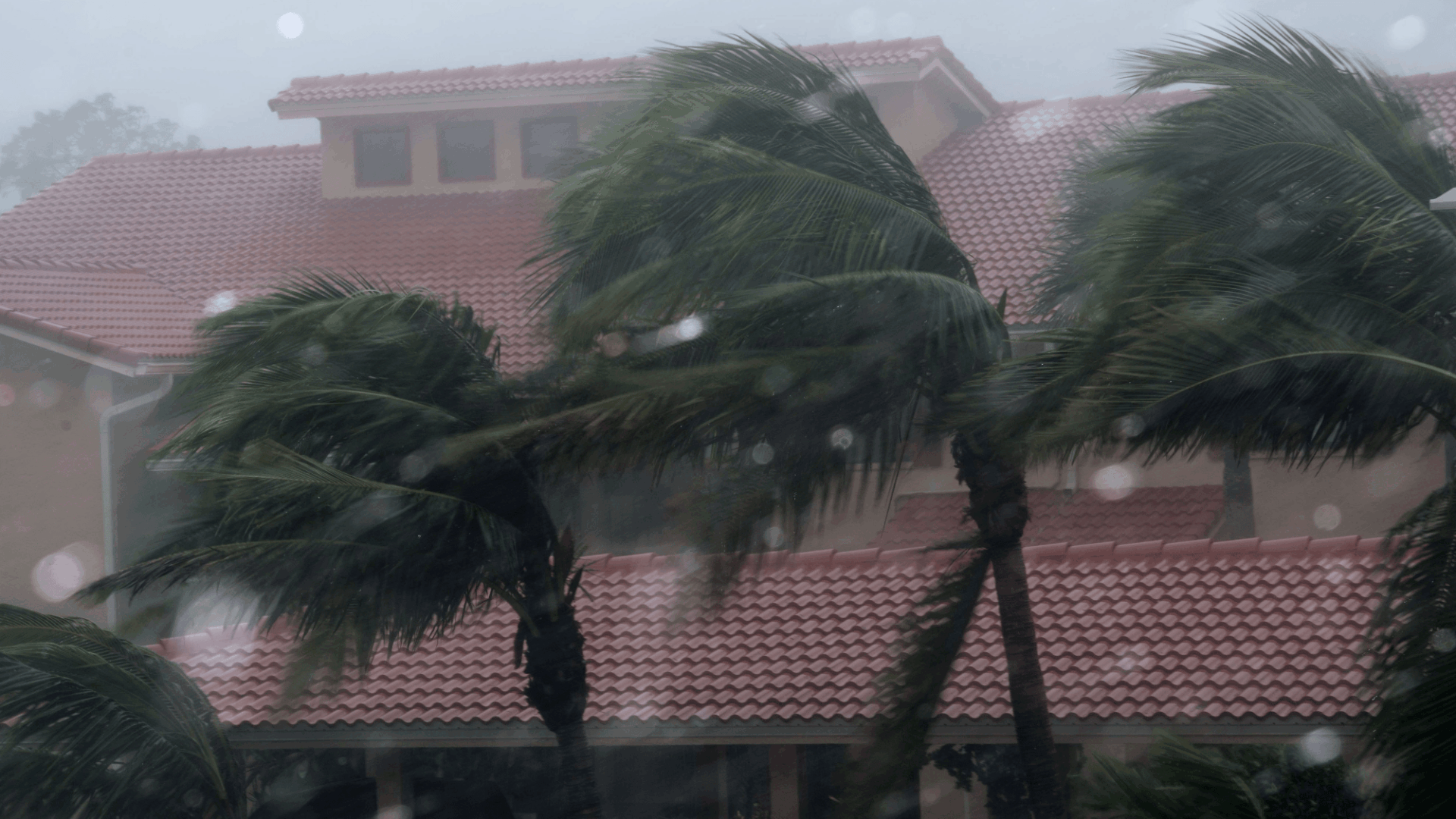
As residents on the northern Gulf Coast brace for quickly strengthening Hurricane Isaias (a Category 3 storm as of Friday afternoon), many are likely eyeing their roofs and walls with nervous anticipation. The Congressional Budget Office estimates hurricane force winds and storm-related flooding collectively cost households in the United States some $34 billion every year. And while rounded corners, sloped walls and reinforced construction can help mitigate some wind damage, these additions are often expensive or impractical for developers looking to cut costs. Engineers at Florida A&M University and Florida State University think they’ve found a resourceful alternative, and it involves embracing the ocean’s own wavy aesthetic.
For a study recently published in the journal Engineering Structures, the team built 3D-printed models of several low-rise buildings with wave shaped walls and roofs and tested them in a wind tunnel. The designs with the deepest waves, (in this case 10 percent of the building’s overall height) cut peak wind pressure near roof and wall corner by up to 60 percent. Those corners and edges are where damaging forces typically concentrate. Surprisingly simple designs like these could become increasingly attractive to develop in the coming years, as more and more communities brace themselves to endure stronger and more frequently occurring storms.
“These nonconventional building shapes reduce the damage from worst-case severe weather scenarios,” Pedro Fernández-Cabán, a study co-author and Florida State University civil engineer, said in a statement. “It’s another tool for engineers and designers to protect against wind damage.”
Bigger waves means better protection
To test their idea, Fernández-Cabán and his colleagues started by 3D printing various models of low-rise buildings. Some of the buildings had wavy walls and roofs, while others were built with a more conventional baseline model with flat, straight surfaces. They made three wavy versions, with wave amplitudes of 5 percent, 7.5 percent, and 10 percent. The amplitude measures the wave’s size in proportion to the building’s overall height in feet. So, for a 20-foot-tall building, a 10 percent amplitude would mean waves that extend about 2 feet.
Once the models were printed, the team then put them into a wind tunnel at the university. They measured wind pressure data on their surfaces as wind pelted the modelers from various directions. All of the wave-roofed models experienced reduced wind load compared to the flat version. The deepest wave model performed the best, reducing peak wind pressure near roof and wall corners by between 40 and 60 percent compared to the flat version. At least in theory, that means a building with that design could see significantly less damage when exposed to hurricane-force winds.
The diagram shows how curving structures can help prevent more destructing vortices from forming. Image: Pedro Fernández-Cabán.
The paper includes a useful diagram (above) that breaks down why this wavy design works. When wind flows over a flat surface like a roof, it separates at the leading edge and from a single large, swirling vortex. That creates a zone of low pressure, while higher pressure underneath the building pushes out against the surface. That leads to a suction like effect that, in extreme scenarios, can peel roofs off of a building. Over a wavy surface, the wind skips along like a stone across a lake, forming a series of smaller swirls instead of one big one. That disruption to the wind can prevent high-suction picks from forming. The result is a building that with less exposure to the strongest, points many damaging wind forces than a flat one.
“Changing a building’s shape can significantly reduce the intensity of wind forces it has to withstand,” Fernández-Cabán said.
The researchers caution that this study focused specifically on wind pressure on the model’s surfaces. They’re now running additional experiments to better understand how wind flows around the wavy structures and plan to use computer modeling to fine-tune the wave patterns and test other shapes. If that work bears out similar to the early results, it could make wavy walls and rooms all the more attractive to architects and engineers looking for simple solutions to protect buildings in storm prone areas.
The post Wavy-shaped homes could limit damage from hurricane winds appeared first on Popular Science.
Wavy-shaped homes could limit damage from hurricane winds
