
In the 2025 musical film The Testament of Ann Lee, a radical 18th-century prophetess who claims to speak with God leads her followers from England to America. Remarkably, this story is based on real history.
Even more remarkably, “Mother Ann’s” loyal followers would go on to invent devices you may have in your home right now, from mail order seed packets to the circular saw. And, like the early leader of their faith, one of the most famous of these inventors was a woman.
Who were the Shakers?
An offshoot of the English Quakers, the Shakers or Shaking Quakers called themselves the United Society of Believers in Christ’s Second Appearing. (Their nicknames came from their practice of “shaking” ecstatically during worship.) Shakers were dedicated to a peaceful, simple life that included strict celibacy and productive labor. At the group’s peak in 1840, there were around 6,000 members, mostly in the northeastern United States.
Often persecuted and misunderstood, Shakers sought refuge in isolation. They established egalitarian communes where property and labor were shared, supporting themselves through farming and the sale of homemade goods.
Although men and women lived separately in Shaker communities, they enjoyed equal status. Shaker “Brothers” and “Sisters” were expected to collaborate for the benefit of all. For instance, while Brothers split wood into strips, Sisters wove the strips into baskets for sale.
The Shaker passion for inventing
The Shaker faith encouraged followers to work hard and strive for perfection. This emphasis on industriousness and efficiency inspired many Shakers to become inventors, in areas ranging from medicine to furniture design.
A Shaker colony built this side chair in around 1831. Image: Heritage Images / Contributor / Getty Images / Shaker Colony
Shakers are especially known for their contributions to agricultural technology. These include devices for processing various crops, a tool called the rotary harrow for tilling fields, and a maximally-efficient round design for barns. Shakers were also the first to sell seeds by mail in paper packets, just as they are still sold today. Even clothespins are said to be a Shaker invention.
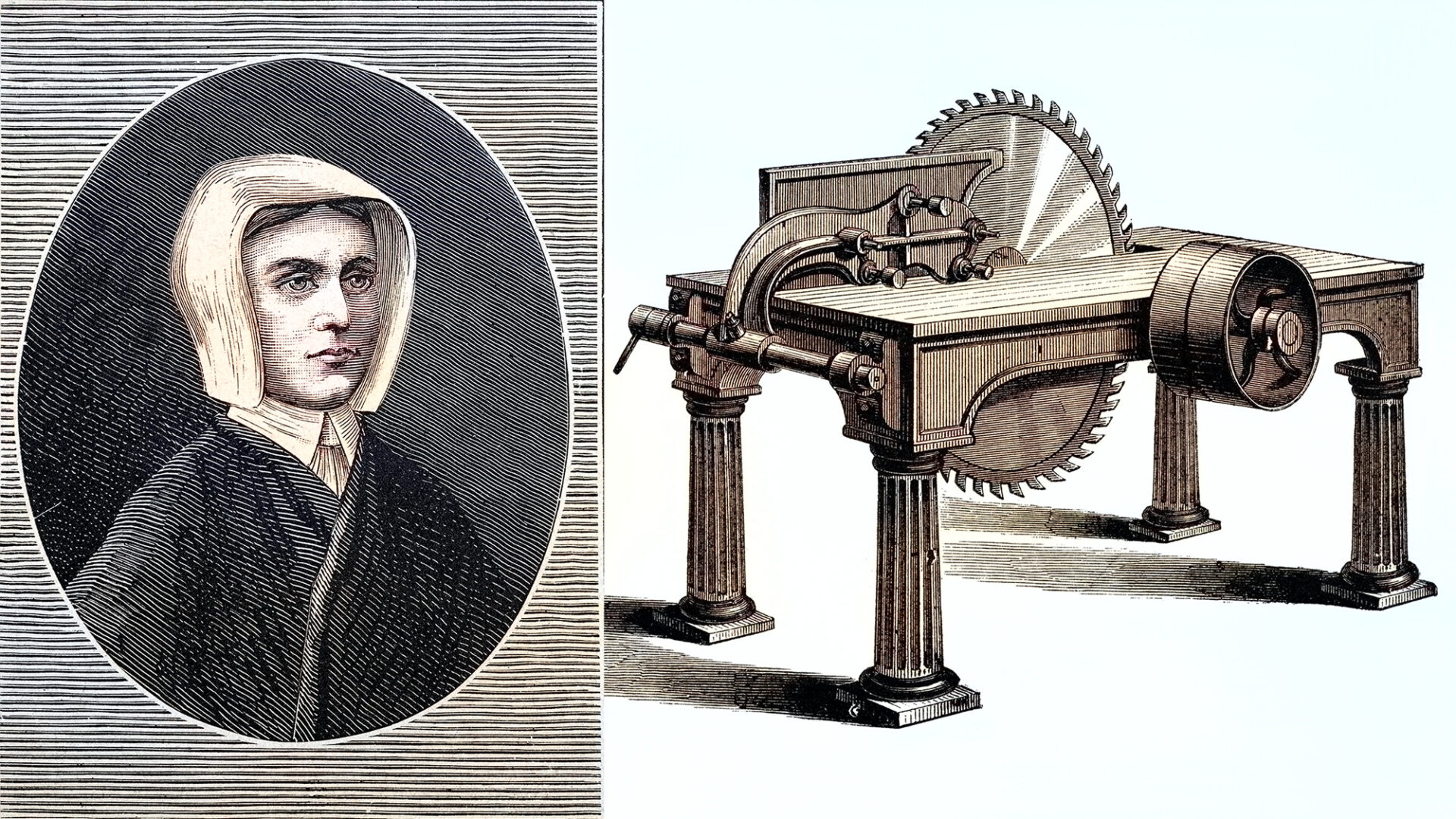
Toolmaker Tabitha Babbitt
Given that both innovation and equality were central to the Shaker way of life, it’s not surprising that some Shaker women became inventors. This includes Sarah “Tabitha” Babbitt (1779–1853), one of the earliest known female inventors in American history.
Babbitt and her parents entered the Shaker community of Harvard, Massachusetts, as converts when Babbitt was 13 years old. “Sister Tabitha” would remain in this community for the rest of her life.
Babbitt is credited with several improvements to existing mechanical processes, such as a method for constructing and fitting false teeth. It’s probably because of her fame that “Babbitt metal,” a soft alloy still used for load-bearing in heavy machinery, is often said to be Shaker in origin. (The metal was actually named after Isaac Babbitt, who was also from Massachusetts, but was not a Shaker or related to Tabitha.)
Babbitt and the circular saw
The most significant invention credited to Babbitt is the circular saw, a predecessor of the electric buzz saw, which she is said to have developed around 1813.
Prior to the introduction of circular saws, Shaker woodcutters cut large logs into lumber using a two-man whipsaw or pitsaw. Each man held one end of a long sawblade, with one standing at the bottom of a pit in the ground (the sawpit) and the other at the top of the pit. The two men hoisted the saw up and down to slice through a piece of wood laid between them.
Sawing with a pitsaw requires less force than sawing from side to side on level ground because the pitsaw is pushed by gravity on the downward stroke. It was an improvement on earlier methods, but inventors like Babbitt pondered how to make the process even more efficient.
An 1835 image of the Shakers performing their distinctive trembling dance. Image: Getty Images / Stringer / MPI
Like other Shaker Sisters, Babbitt would have been an experienced spinner (in fact, she is also said to have invented an improved spinning wheel head). According to the records of the Harvard Shaker community, Babbitt cut her original prototype sawblade out of tin and attached this to the spindle of a spinning wheel. The blade, affixed to a pulley mechanism, would rotate would rotate when operated by a foot pedal below the machine, similar to how the spinning wheel itself worked. Wood could then be cut by being pushed against the rotating blade, requiring even less effort from the operator. Depending on the size of the saw, the device could also be operated by a single person.
Subsequently, Shaker Brothers made steel blades according to Babbitt’s design. The device was so successful that it quickly spread to other Shaker communities, as well as to non-Shakers. By the 1820s, many Shaker lumber mills were equipped with circular saws, and in 1839, the mill at the largest Shaker community in Mount Lebanon, New York, had six of them.
Tracing Shaker inventions
The Shaker belief in communal property prevented inventors from seeking patents and made them happy to share their designs with others. This means that tracing Shaker inventions is a challenge for historians, and Shaker inventors often don’t get credited by name.
In 2005, inventor Sam Asano criticized the induction criteria for the National Inventors Hall of Fame using Babbitt and Benjamin Franklin as examples of historically important inventors who never filed patents.
Even if Babbitt did invent the circular saw, she does not seem to have been the only one, or even the first. In England, Samuel Miller was awarded a patent for a circular saw in 1777, two years before Tabitha Babbitt was born. Miller’s saw is unlikely to have spread to the Shakers, who had followed Mother Ann to the American colonies in 1774.
According to Robert Meader, a 20th-century director of a Shaker history museum, the circular saw was used as early as the 17th century in the Low Countries (modern Belgium, Luxembourg, and the Netherlands), “but the trade guilds would not let it out of the country.”
Later, Meader explained, Babbitt and others “re-invented” the device independently several more times. Later inventors would design new forms of circular saws, such as those powered by a handcrank instead of a foot pedal.
In the book Inspired Innovations: A Celebration of Shaker Ingenuity, editor Stephen Miller notes that different individuals were credited with inventing the circular saw even among the Shakers. Whoever made the device first, the Shakers “do appear to have been among its earliest users, and may have created new forms and uses for it,” Miller wrote.
Related ‘The History of Every Thing’ Stories
Inventor Beulah Louise Henry’s unstoppable rise to becoming ‘Lady Edison’
Biscotti once fed Roman navies and Christopher Columbus’s expeditions
The forgotten story of the woman who invented the dishwasher
Windshield wipers’ overlooked female inventor
From real nails to kangaroo leather: Soccer cleats went on a wild journey
The decline of the Shakers
Despite their love for new technology, it was the rise of industrialization in the 1870s that spelled the end for the Shakers. Cheap, mass-produced factory goods proved steep competition for the slower, more expensive work of Shaker artisans. Many Shaker communities were forced to close as Brothers and Sisters left the faith to seek conventional employment.
It didn’t help that new U.S. child welfare and adoption laws also made it much more difficult for communal religious societies like the Shakers to adopt children. The celibate Shakers had once grown their numbers by adopting orphans, but now they could only grow through conversion: Just when their way of life was becoming unsustainable. With more people leaving the Shakers than joining, their numbers dwindled.
Today, the Shakers live on through the things they created, from their music, to their sleek, minimalistic furniture, to the numerous inventions that Tabitha Babbitt and her Brothers and Sisters designed.
Yet the Shakers are not entirely extinct, and their plain living and hard work still appeal to some. The last active Shaker community, located in Maine, has three members as of 2026, one of whom joined just last year. What might they invent next?
In The History of Every Thing, Popular Science uncovers the hidden stories and surprising origins behind everyday things.
The post The Shaker woman who reinvented the circular saw appeared first on Popular Science.
