
On May 1, 1893, Chicago was abuzz. Two hundred thousand people jostled for a glimpse of the brand new city within the city, the so-called “White City.” Dignitaries, civic leaders, and politicians had all traveled far and wide to attend the day’s spectacle. Even President Grover Cleveland joined the festivities.
After President Cleveland gave a triumphant speech about American progress, he pressed a single golden telegraph key at exactly 12:08 p.m.—a small act that ushered in the “electric age,” The Salt Lake Herald later reported. “President Cleveland, by pressing a button, started the mighty machinery, rushing waters and revolving wheels” throughout the massive complex of buildings that covered more than 630 acres. The 1893 World’s Columbian Exposition in Chicago was officially open to the public!
Often referred to as the Chicago World’s Fair, the World’s Columbian Exposition was full of firsts—the first Ferris wheel, the first commercial movie theater, the first large-scale use of electric lights, the first automatic dishwasher, even the first brownies.
Today, little remains of the fair that changed history. Chicago’s main art museum, the Art Institute of Chicago, was the only permanent building built for the fair. Some of the fair’s buildings were later rebuilt, such as the stunning Palace of Fine Arts that today houses the Museum of Science and Industry. In Jackson Park, where much of the fair occurred, all that’s left from 1893 is a small, wooded island and a 24-foot replica of the Statue of the Republic. Both of which many people pass daily without knowing their full importance or ties to one of history’s most impressive spectacles.
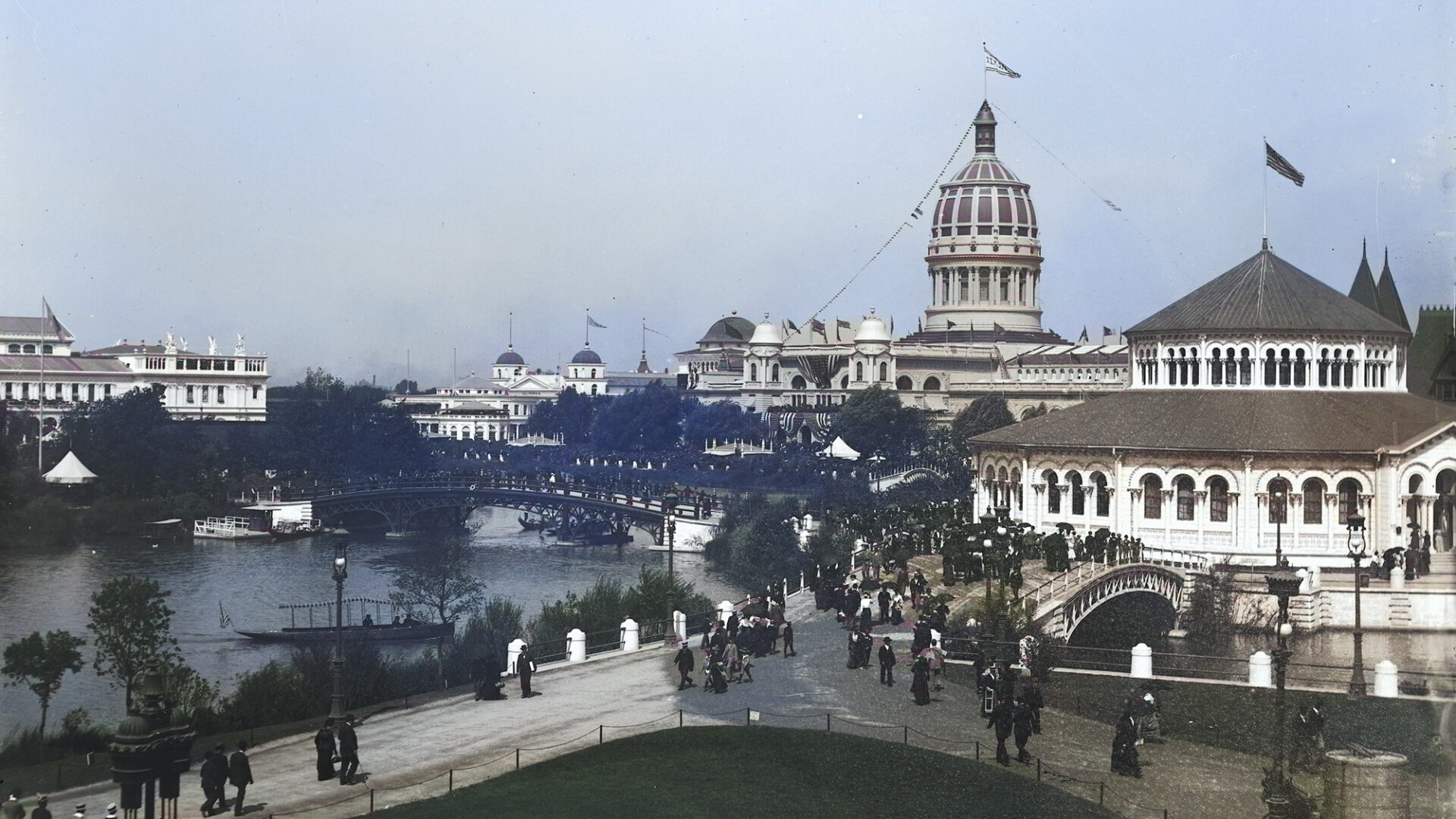
Despite this, the fair’s legacy continues in small ways; every time you turn on the lights, use a zipper, or even have a piece of Juicy Fruit gum. And then there’s the photos. These rare, colorized images (click to expand images to full screen) of the 1893 World’s Columbian Exposition help us imagine the true scale of the Chicago fair that changed history.
The World’s Columbian Exposition’s massive buildings were barely completed in time for the fair’s May 1 opening. American architect Daniel Burnham was the event’s Director of Works, supervising the design and construction of all the buildings for the fairgrounds. It was a massive undertaking. The subsequent buildings showcased Neoclassical, Beaux Arts, and classical Renaissance designs. Burnham told a local Chicago newspaper, “The influence of the Exposition on architecture will be to inspire a reversion toward the pure ideal of the ancients.” Image: Public Domain
On October 21, 1892, thousands of people crowded into the still-unfinished Manufactures and Liberal Arts Building of the Chicago World’s Fair. That year was supposed to be when the fair opened, to coincide with the 400th anniversary of Christopher Columbus’s voyage to the New World. But construction delays meant the fair didn’t open until a year later, in 1893. Image: Public Domain
The interior of the colossal Manufactures and Liberal Arts Building at the Chicago World’s Fair showcased numerous exhibits. The building was the fair’s biggest, clocking in at 1,687 feet long by 787 feet wide and covering a total of 31 acres—making it four times larger than the Roman Colosseum. Image: Public Domain
This color lithograph shows another view of the interior of the Manufactures and Liberal Arts Building. Charles S. Graham made the lithograph for The Chicago Tribune Art Supplements in 1893. Image: Public Domain
In 1893, the Horticulture Building at the Chicago World’s Fair was the largest hothouse ever constructed. Its massive, 184-foot-tall dome overflowed with plant life from all around the world. Image: Public Domain
This color plate by Charles S. Graham shows the view looking east across the Grand Court, also known as the Court of Honor. Through the four-sided courtyard ran a massive canal, the Grand Basin, which marked the center of the fair. A complex of white palaces surrounded the Basin, including the Manufactures and Liberal Arts Building. Decorative fountains and bridges also dotted the water feature. Image: Public Domain
A segment of the “General Noble” giant sequoia on display at the fair. The Kings River Lumber Company cut down the massive tree in present-day Sequoia National Park in 1892. The tree was more than 300 feet tall, approximately the height of the Statue of Liberty from the tip of her torch to the grass beneath. Image: Public Domain
Visitors to the fair walk in front of the 4,800-square-foot India Pavilion (also called the East India Building). Chicago-based architect Henry Ives Cobb designed the pavilion to mimic Mughal architecture, evoking Fatehpur Sikri’s Buland Darwaza and Delhi’s Jama Masjid. The building was brilliantly painted, and both its design and color were intended to “render the structure a striking object among the cosmopolitan specimens of architecture,” journalist and former Confederate soldier William E. Cameron wrote in his book, The World’s Fair: Being a Pictorial History of the Columbian Exposition. Image: Public Domain
The post The 1893 Chicago World’s Fair in 9 stunning color photos appeared first on Popular Science.
The 1893 Chicago World’s Fair in 9 stunning color photos
