
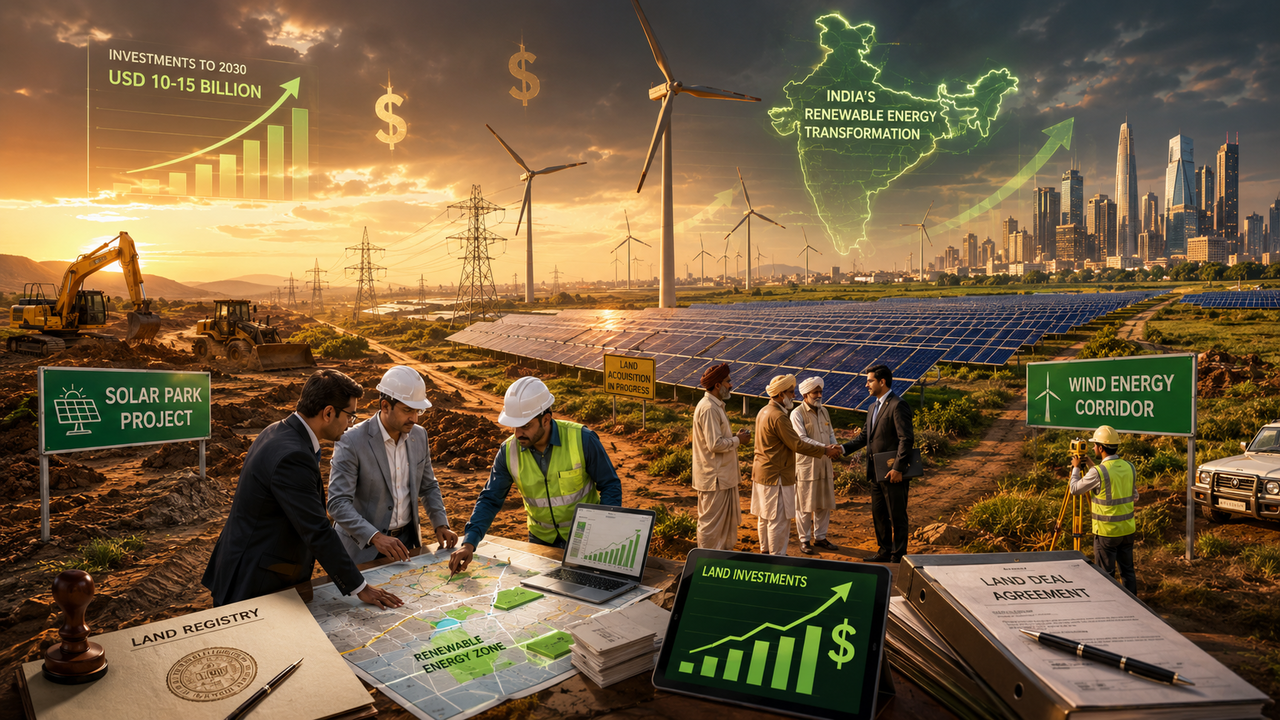
India is set to witness an uptick in the renewable energy sector landscape is poised for significant expansion in the coming years supported by strong policy push and increasing investments especially in solar and wind energy.
According to an estimate by Colliers India, by 2030, the upcoming solar and wind projects, would translate into USD 10–15 billion opportunity in land aggregation & acquisition.
The report said an estimated USD 110-120 billion investment is expected to flow into the renewable energy sector in the next few years, primarily for solar and wind projects. Land aggregation & acquisition accounts for around 10–12% of total costs for solar and wind projects.
With an estimated 270–300 GW of capacity additions anticipated in the coming years, nearly 7 lakh acres of land will be required for solar and wind projects, significantly increasing the demand for land parcels across key regions.
For solar projects, majority of the land is aggregated and acquired either by private developers or central/state-level nodal authorities in case of relatively larger parks.
For wind projects, land is primarily acquired for construction of electrical substations and other critical infrastructure, while the area around turbine sites is often secured through leasing arrangements.
Multiple entry points for real estate players:
The report suggested that the upcoming solar & wind projects present multiple entry points for real estate players and construction companies.
Colliers India highlighted that the private sector participation could potentially increase significantly in land aggregation & acquisition, EPC solutions, O&M facilities etc in the next few years.
Further, the warehousing demand by renewable energy OEMs is set to grow further, aided by growth of ultra-mega projects and incentivization of domestic production, it added.
As of 2025, installed renewable energy capacity stood at around 251 GW, with solar and wind energy continuing to anchor the capacity mix.
With non-fossil sources (renewables and nuclear energy) accounting for 51% of the existing installed capacity and rapid advancements in domestic manufacturing capabilities, India is well positioned to comfortably achieve its target of 500 GW non-fossil-based capacity by 2030, the report added.
