
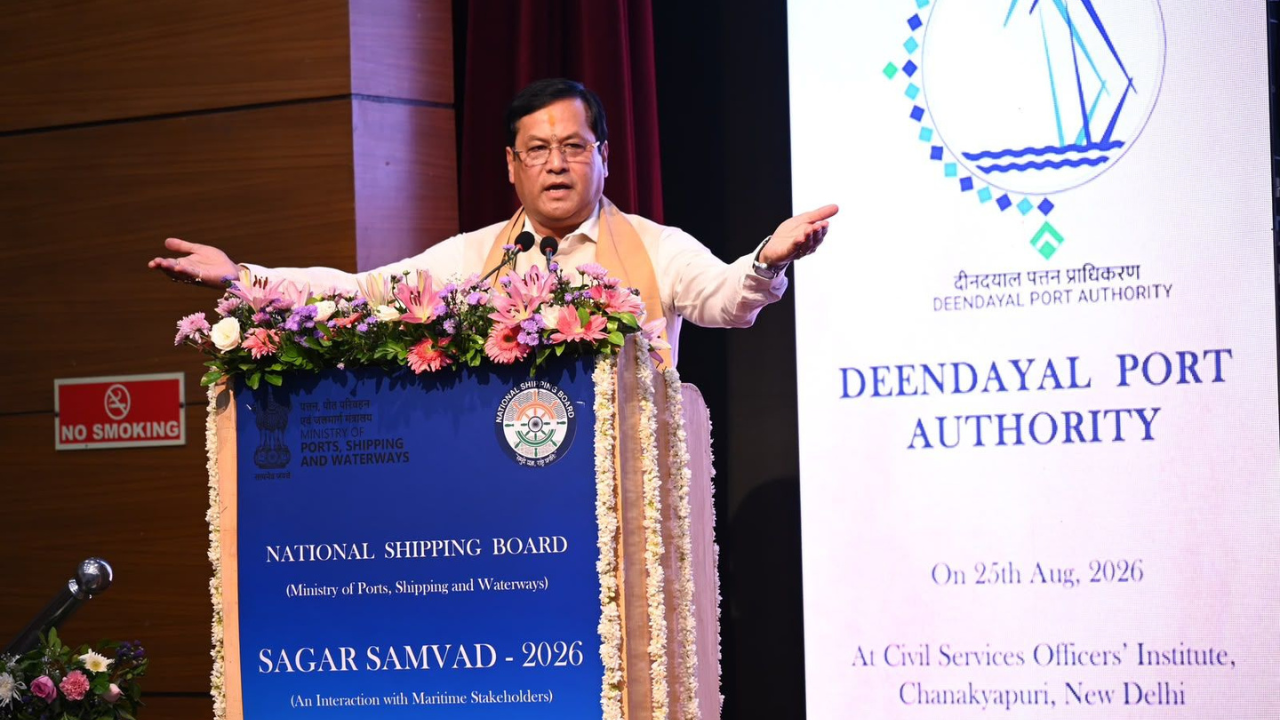
Union Minister for Ports, Shipping and Waterways Sarbananda Sonowal has said India is examining alternative maritime routes to keep cargo movement going amid continued disruption around the Strait of Hormuz due to the Middle East conflict. With heightened risks in the region adding to the cost and complexity of shipping, the government is looking at options that can help vessels maintain the flow of goods to India and global markets.
Sonowal said the country has several opportunities to explore alternative routes and that authorities are actively assessing them to ensure maritime trade remains resilient.
“For us, there are several opportunities across the world to explore alternative routes and we are going to explore them all. We want to ensure that our vessels continue to move forward with cargo to meet the evolving needs of the global market as well as our nation’s requirements. That is why we are continuously working on identifying and developing such opportunities, and we are successfully handling them,” Sonowal said on Tuesday on the sidelines of Sagar Samvad 2026.
The minister’s remarks come as the Strait of Hormuz remains a key concern for the global shipping industry. The strategically important waterway is a major passage for international energy and cargo flows, making disruptions in the region a potential challenge for shipping companies, exporters and importers.
Sonowal Assures Safety Support For Seafarers
While the government explores alternate routes, Sonowal also stressed that the safety and welfare of Indian seafarers remain a priority for authorities. “All agencies are working 24*7 for the safety of our seafarers. We are particularly committed to the Safety security and Welfare policy wherever our seafarers are working,” the union minister said.
“With technologies like tracking facilities on our digital platforms that DG Shipping have already developed, we are also operating helplines for seafarers wherever they are working, whether it is foreign flag or Indian flag. These will help them to communicate and raise their issues before DG Shipping,” Sonowal added.
The government is using tracking systems and dedicated helplines to maintain communication with seafarers and provide channels through which concerns can be reported to the Directorate General of Shipping.
The measures cover seafarers working on both Indian-flagged and foreign-flagged vessels, according to the minister. The stress on monitoring and communication comes as maritime workers continue to operate in an environment where geopolitical tensions can affect shipping routes and operating conditions.
Insurance Emerges As A Major Cost For Ships Crossing Hormuz
The disruption is also having a direct financial impact on vessels that continue to use the Strait of Hormuz. Shyam Jagannathan, Director General of Maritime Administration, said insurance costs have emerged as one of the most significant additional expenses for ships operating through the high-risk route.
“One of the major costs that has been added for ships passing through the Strait of Hormuz is the insurance premium that they are paying. Companies are charging a lot more than what they used to charge before February, before the start of the Middle East conflict. It is becoming one of the biggest cost factors in the shipping market for ships crossing through Hormuz. Some insurance companies are charging almost a year’s worth of insurance for a single shipment. The insurance being charged by these companies also depends on the areas and the level of risk involved through which the shipments are crossing. So, one of the most important factors adding to the cost of shipments crossing the Strait of Hormuz amid the Middle East conflict is the insurance amount that shipping companies are paying to cross the Strait of Hormuz,” he said.
The sharp increase in premiums highlights the growing cost burden for companies choosing to operate through the route. Insurance charges vary depending on the location of a voyage and the perceived level of risk associated with the waters through which a vessel travels.
