
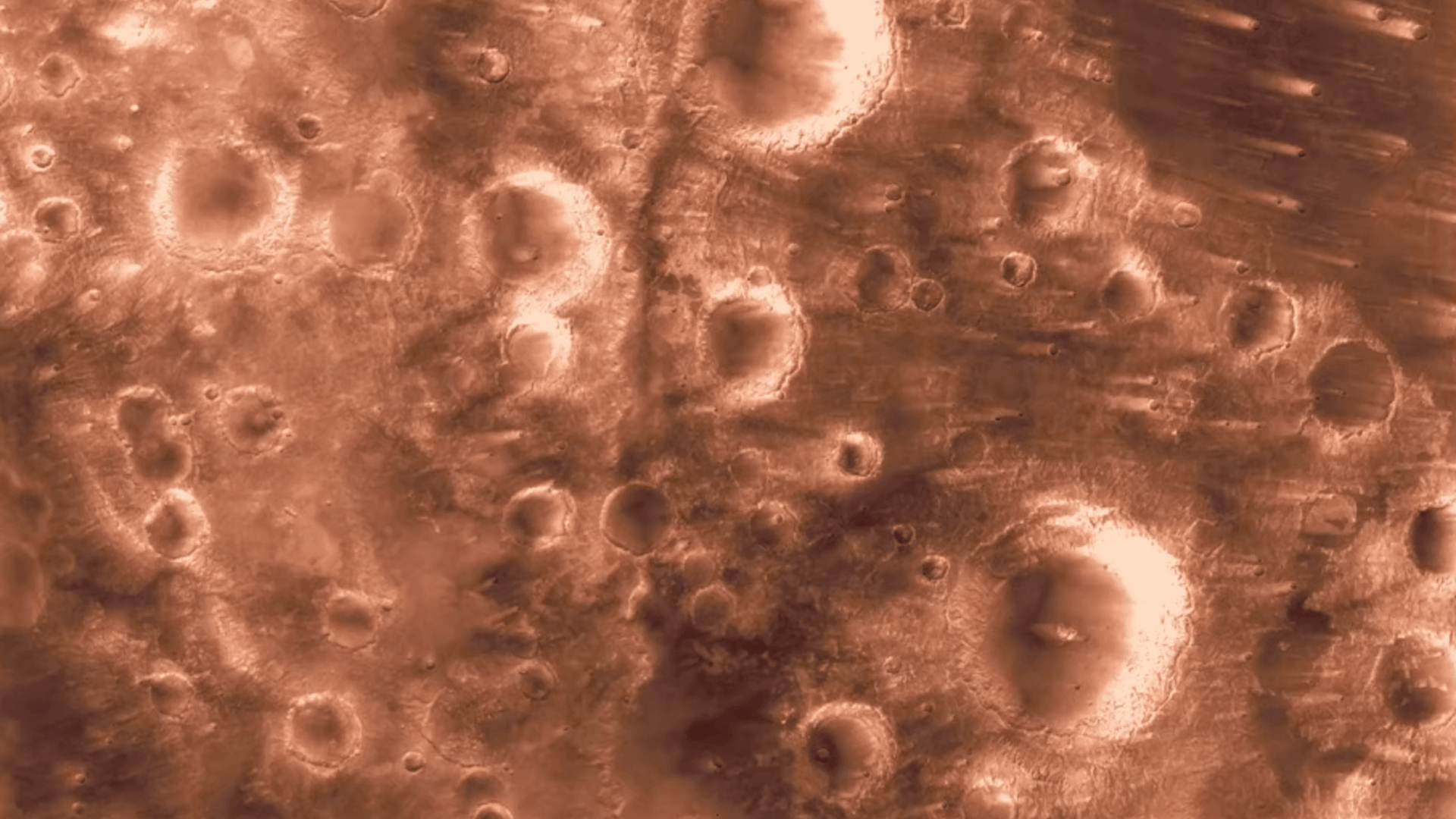
NASA’s asteroid-hunting Psyche spacecraft recently needed a little gravitational assist from Mars to keep speeding towards its intended target, but it didn’t leave the Red Planet empty-handed. While testing its various research instruments ahead of using them on the distant, metal-rich space rock 16 Psyche in 2029, the spacecraft snapped a travel album’s worth of flyby photos with its pair of identical cameras.
NASA has released a compilation of the images taken during Psyche’s monthlong slingshot path in May. And unlike the thin crescent vantage point seen earlier, the stunning close-ups showcase the windswept surface, massive craters, and even the solar polar ice cap on Earth’s closest planetary neighbor.
“The imager performed brilliantly, delivering some rarely seen views of the Red Planet,” Jim Bell, Psyche’s imager instrument lead at Arizona State University, said in a statement.
In addition to the pictures themselves, the team successfully tested Psyche’s camera calibrations and scattered light sensitivity. These trial runs also included highlighting Martian moons Phobos and Deimos—a process that will be repeated at the asteroid to hopefully locate any potential orbital moonlets. Meanwhile, mission specialists tested Psyche’s neutron and gamma-ray spectrometer. Planetary bodies and asteroids emit neutrons and gamma rays while absorbing waves of high-energy cosmic rays. Researchers can then use these waves to match with known elements to determine the object’s chemical makeup. At its closest flyby altitude of 2,864 miles, Psyche remained too far away to pick up any Martian gamma rays, but the team hoped to possibly flag neutrons as they left the planet.
“Around the time of Mars’ closest approach, the neutron spectrometer detected a count-rate enhancement close to what we anticipated. It was very gratifying to see,” said spectrometer science lead David Lawrence.
Then there is Psyche’s magnetometer. The instrument will eventually analyze the asteroid’s core, whose metal composition will reveal if it’s a rocky planet building block known as a planetesimal. Psyche’s magnetometer will still be a very useful tool before it reaches its target. It has been running ever since the spacecraft’s launch in 2023 so that researchers can measure solar winds. As it approached Mars, the equipment relayed a huge increase in its magnetic field that aligned with an area of the planet that absorbs the most solar wind known as the bow shock region.
“We didn’t anticipate big discoveries, given how extensively the planet has been studied, but we did complement Mars science with the data we collected through Psyche’s unique perspective,” said Lindy Elkins-Tanton, Psyche’s principal investigator at the University of California, Berkeley.
With Mars in the rear view mirror, Psyche is now continuing along its 2.2-billion-mile journey to its diminutive asteroid, with even more work to do.Next up is restarting its solar-electric propulsion system to supply sustained thrust, which specialists expect to handle later in the year.
The post Mars’ desolate desert landscape captured by asteroid-bound NASA spacecraft appeared first on Popular Science.
