
India and the United Kingdom are set to operationalise their Comprehensive Economic and Trade Agreement (CETA) from July 15, marking one of the biggest milestones in economic ties between the two countries. The agreement is designed to uplift bilateral commerce by lowering tariffs, widening market access and strengthening collaboration across goods and services. Officials have said preparations are in the final stages to ensure customs systems and implementation mechanisms are ready before the pact comes into force.
According to an ANI report, the aim is to make sure businesses can immediately claim preferential benefits on eligible shipments from the very first day.
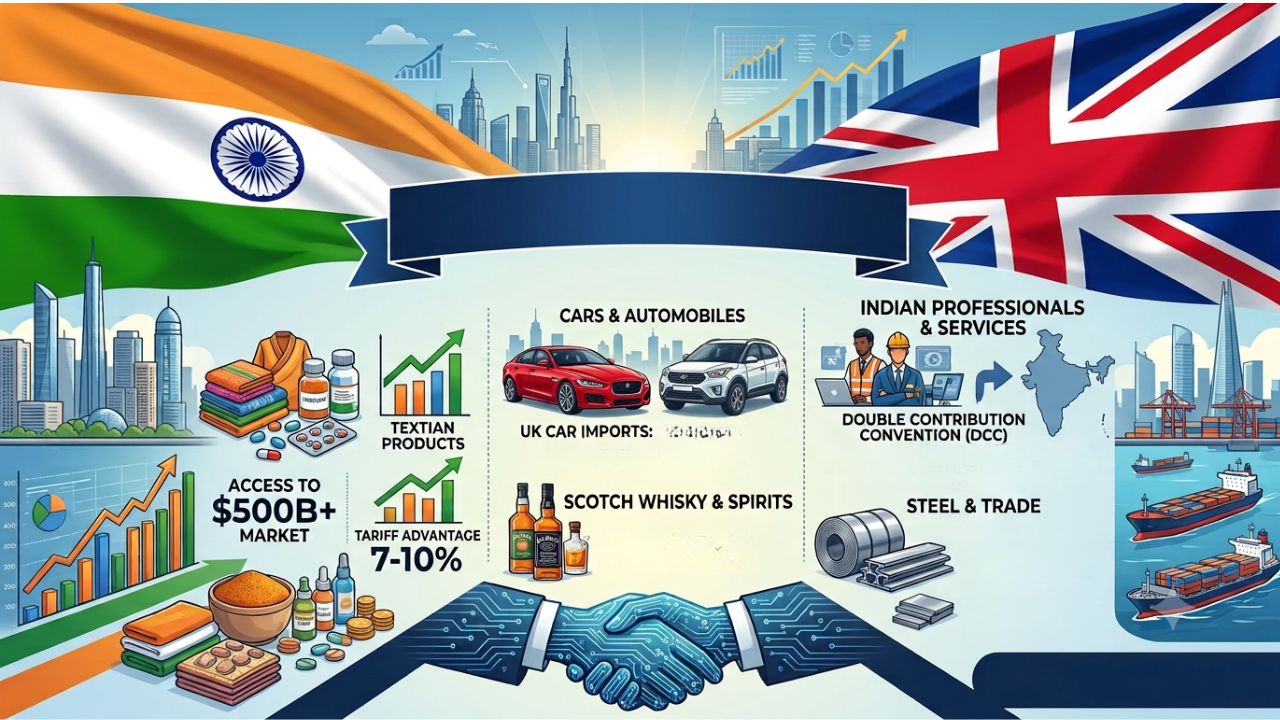
The trade agreement is expected to provide Indian exporters with access to a market valued at more than $500 billion. Officials believe exporters will enjoy tariff advantages of around 7-10 per cent compared with the current trade framework, while duties on more than 99 per cent of tariff lines are scheduled to be phased out over time.
Instead of a uniform tariff structure, the agreement adopts a mixed approach for certain sensitive sectors. While tariffs on most products will eventually be eliminated, select categories will continue to operate under quota-based restrictions to balance domestic industry interests, ANI reported.
Cars, Whisky And Steel Among The Biggest Beneficiaries
One of the most closely watched provisions relates to automobiles. Under the agreement, India will gradually allow imports of up to 3.78 lakh petrol and diesel passenger vehicles from the UK over a 15-year period through a quota system. Import duties in specified categories will decline from around 110 per cent to 10 per cent during the implementation period, with separate treatment based on engine size and vehicle type, PTI reported.
Electric, hybrid and hydrogen-powered vehicles will receive limited market access beginning in the sixth year. However, lower-priced electric vehicles remain outside the scope of tariff concessions, reflecting India’s focus on protecting its domestic EV industry.
The pact also delivers significant relief for the UK’s spirits industry. Import duties on Scotch whisky and gin will be reduced from 150 per cent to 75 per cent initially before falling further to 40 per cent by the tenth year.
The International Spirits and Wines Association of India (ISWAI) welcomed the move, noting that lower tariffs on Scotch whisky, including bulk imports used for blending and bottling in India, would benefit manufacturers and expand consumer choices. According to the association, nearly 79 per cent of Scotch imported into India is used by domestic companies for blending and bottling.
However, the Confederation of Indian Alcoholic Beverage Companies (CIABC) urged state governments to withdraw concessions currently extended to bottled-in-origin imported brands, arguing that lower import duties coupled with state-level incentives could make imported products cheaper than domestically manufactured alcoholic beverages, as quoted by PTI.
The agreement also addresses India’s concerns over UK steel safeguard measures. ANI reported that nearly 85 per cent of India’s steel exports will remain outside restrictive measures, while concessions have been secured across 188 tariff lines. Officials added that discussions on unresolved issues will continue at the World Trade Organisation (WTO).
Relief For Indian Professionals And Services Sector
The agreement introduces the Double Contribution Convention (DCC), under which Indian professionals temporarily working in the UK will not be required to pay social security contributions for up to five years. The provision is expected to reduce costs for Indian IT and services companies while improving their competitiveness in the UK market. PTI reported that the arrangement aligns India with several other countries that already enjoy similar social security agreements with Britain.
Beyond goods trade, the pact is also expected to strengthen exports in sectors such as information technology, financial services, education and professional consulting. Investment ties are also likely to deepen, with more than 900 Indian companies already operating in the UK.
