
It’s difficult to overstate just how much the Large Hadron Collider (LHC) has helped advance our understanding of the universe. Since its debut in 2008, the 16.7-mile-wide subatomic smasher buried underneath Switzerland proved the existence of the Higgs boson particle (aka the God particle), highlighted the perplexing nature of muons, and even measured antimatter. Apocalyptic conspiracy theories to the contrary, it expanded on key concepts in quantum physics, while charting a path forward for researchers around the world.
Still, all good things must come to an end. On June 29, CERN announced that the LHC had officially entered “Long Shutdown 3,” thus ceasing operations after 18 years of remarkable work. But in keeping with some of the most mindbending quantum physics concepts, the LHC is technically both dead and not dead at all.
Instead of a total decommission, the collider is now on schedule to begin receiving upgrades that will transform it into an even more powerful version of itself. The Large Hadron Collider is dead—long live the High-Luminosity Large Hadron Collider (HiLumi LHC).
“The LHC has exceeded every expectation,” CERN Director for Accelerators and Technology Oliver Brüning said in a recent statement. “Today we say goodbye to the LHC as we have known it, while preparing to welcome its successor…which will extend this scientific adventure far into the future.”
The LHC went dormant to receive upgrades and recalibrations during two prior Long Shutdowns in 2013–2015 and 2015–2018. However, these upcoming additions are major enough to usher in an entirely new phase of the atom smasher’s existence. Over the next four years, CERN and its collaborators will renovate the entire LHC complex and its facilities. These will include consolidating the North Area’s Super Proton Synchrotron, deconstructing the CERN Neutrinos to Gran Sasso target area, as well as overhauling a section called the Experimental North Cavern 3 into a high-intensity fixed-target section. Researchers estimate that around 0.75 miles of magnets and other components will be removed and replaced entirely with new technology.
“The LS3 represents a huge and complex logistical and engineering undertaking,” said LS3 Coordination Team director Jean-Philippe Tock.
Unsurprisingly, starting up the new HiLumi LHC won’t be as simple as flipping a switch. A gradual reboot will begin in 2028 before becoming fully operational in 2030. As its name implies, the HiLumi LHC will generate a luminosity ten times greater than its predecessor, allowing it to gather data on the subatomic world in much greater detail while investigating subjects like the Higgs boson. From there, the potential for new discoveries is as vast as the universe itself.
The post Farewell, atom-smashing Large Hadron Collider appeared first on Popular Science.
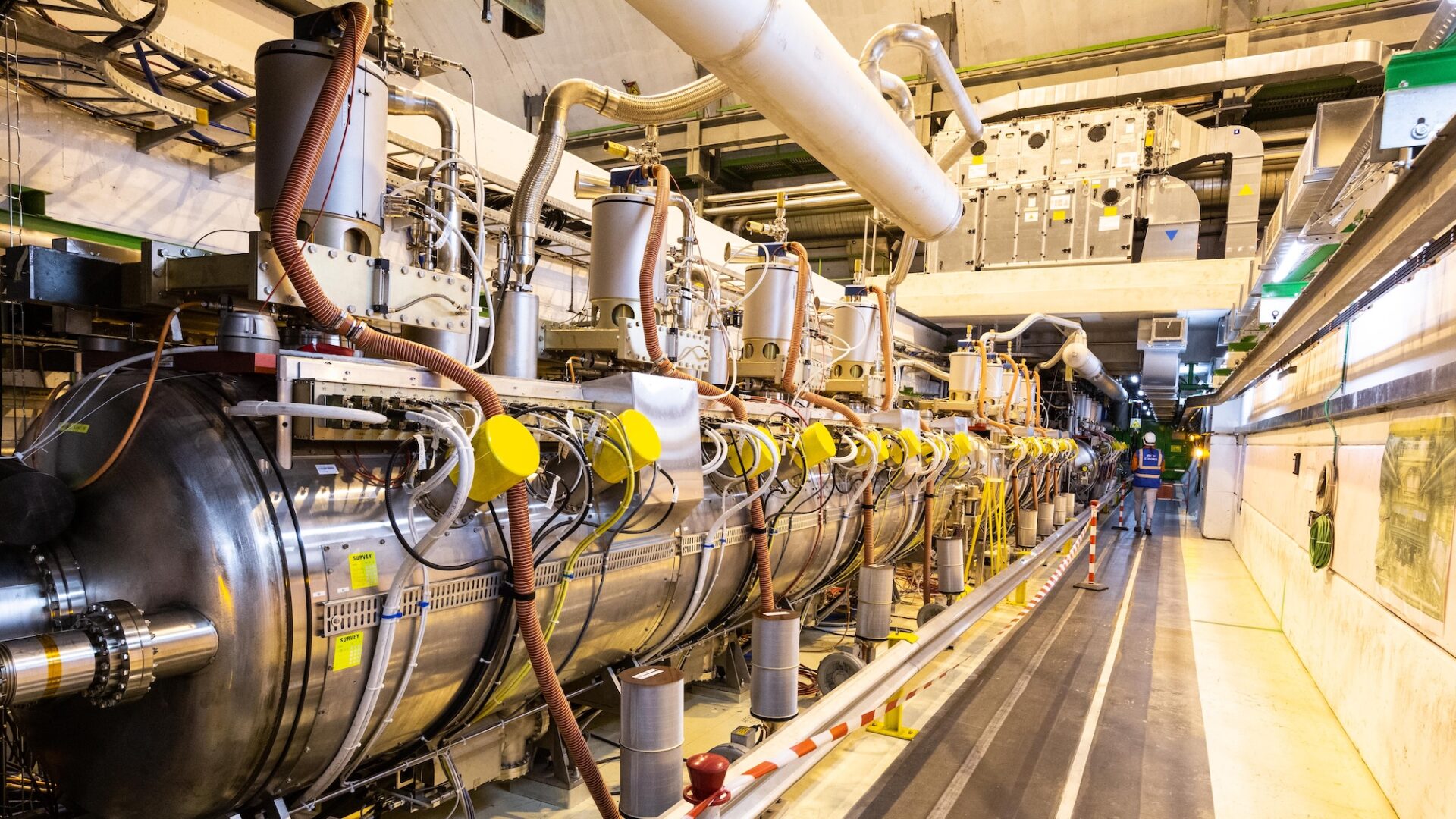
Farewell, atom-smashing Large Hadron Collider
previous post
