
A rechargeable battery based on technology pioneered by Thomas Edison may finally get its due. But while the famous inventor envisioned nickel-iron batteries powering the automobile industry over a century ago, researchers now believe the underlying concepts are more suited for renewable energy centers. According to a study published in the journal Small, a team including engineers from the University of California, Los Angeles have developed a prototype battery that recharges in seconds and withstands over 12,000 cycles of use—an equivalent to over 30 years of daily activity.
Rechargeable electric power isn’t a new concept. By 1900, there were actually more electric-hybrid cars on roads in the United States than gas-powered rides. In 1901, Edison famously patented a working lead-acid automotive battery that nearly ushered in an entirely different 20th century. Unfortunately, the battery’s cost and its 30-mile range ultimately lost out to the internal combustion engine before Edison could ever realize a nickel-iron battery successor.
Today, renewable energy is firmly established after more than a century of innovations—as well as the destructive consequences of fossil fuels. While most people are familiar with rechargeable lithium-ion batteries, Edison’s nickel-iron concept isn’t completely dead. UCLA engineers concede that while the technology isn’t necessarily well-suited for transportation, it shows incredible promise for use in infrastructure facilities like solar farms.
Although the device’s foundations rely on atomic-level bonds at nanoscale levels, biochemists like study coauthor Maher El-Kady say the principles are comparatively easy to grasp.
“People often think of modern nanotechnology tools as complicated and high-tech, but our approach is surprisingly simple and straightforward,” he said in a recent UCLA profile.
El-Kady’s team drew their inspiration from two primary sources: elemental chemistry and skeletal anatomy. Both vertebrate bones and shells form by employing certain proteins as framework for calcium-based compounds.
“Laying down minerals in the correct fashion builds bones that are strong, yet flexible enough to not be brittle. How it’s done is almost as important as the material used, and proteins guide how they are placed,” explained materials scientist and study coauthor Ric Kaner.
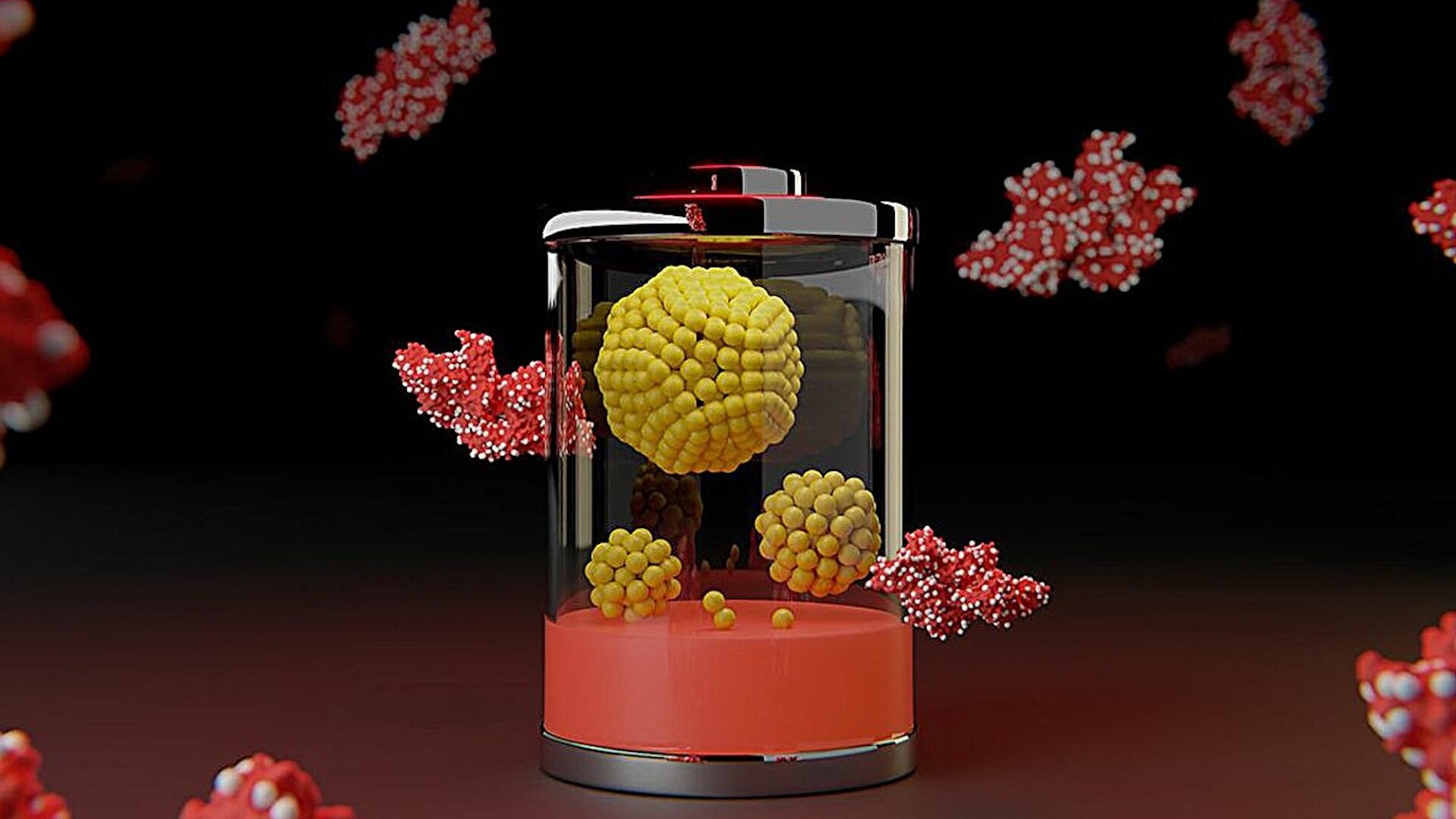
El-Kady and Kaner wondered if they could adapt this system by swapping out the calcium for nickel and iron. For their proteins, they turned to leftover byproducts from beef processing and imbued them with graphene oxide—a single-atom-thick sheet of carbon and oxygen. In the end, they managed to grow a folded protein structure filled with positive electrode nickel atoms and negatively charged iron. At less than five-nanometers-wide, it would take 10,000 to 20,000 clusters to reach the width of a human hair.
Graphene oxide’s oxygen atoms typically function like an insulator, which would hinder a battery’s efficacy. The team had a solution, however. After placing their creation in superheated water, the high temperatures baked the proteins into carbon while eliminating all of the oxygen. At the same time, those metallic clusters are further embedded into the structures. The result was an aerogel that is nearly 99-percent air-by-volume. From there, the surprising dynamics of surface area take over.
“As we go from larger particles down to these extremely tiny nanoclusters, the surface area gets dramatically higher. That’s a huge advantage for batteries,” said El-Kady. “When the particles are that tiny, almost every single atom can participate in the reaction. So, charging and discharging happen way faster, you can store more charge, and the whole battery just works more efficiently.”
El-Kady’s nickel-iron aerogel battery currently has nowhere near the storage capacity of a lithium-ion alternative, making it unsuitable for electric vehicles. However, that doesn’t mean it’s simply a neat chemistry experiment. The nickel-iron battery’s rapid charging, longevity, and high output implies that it may work well on a solar farm. The battery could easily and quickly store excess electricity during the day, then transfer that power to the grid at night. There are also scenarios where it may help provide backup power to energy-hungry data centers.
While it’s still early in the rebirth of Edison’s nickel-iron batteries, the science and know-how is there. What’s more, it completely sidestep’s lithium-ion’s reliance on rare earth metals.
“We are just mixing common ingredients, applying gentle heating steps and using raw materials that are widely available,” said El-Kady.
The post Thomas Edison’s failed rechargeable battery may get a second life appeared first on Popular Science.
Thomas Edison’s failed rechargeable battery may get a second life
