
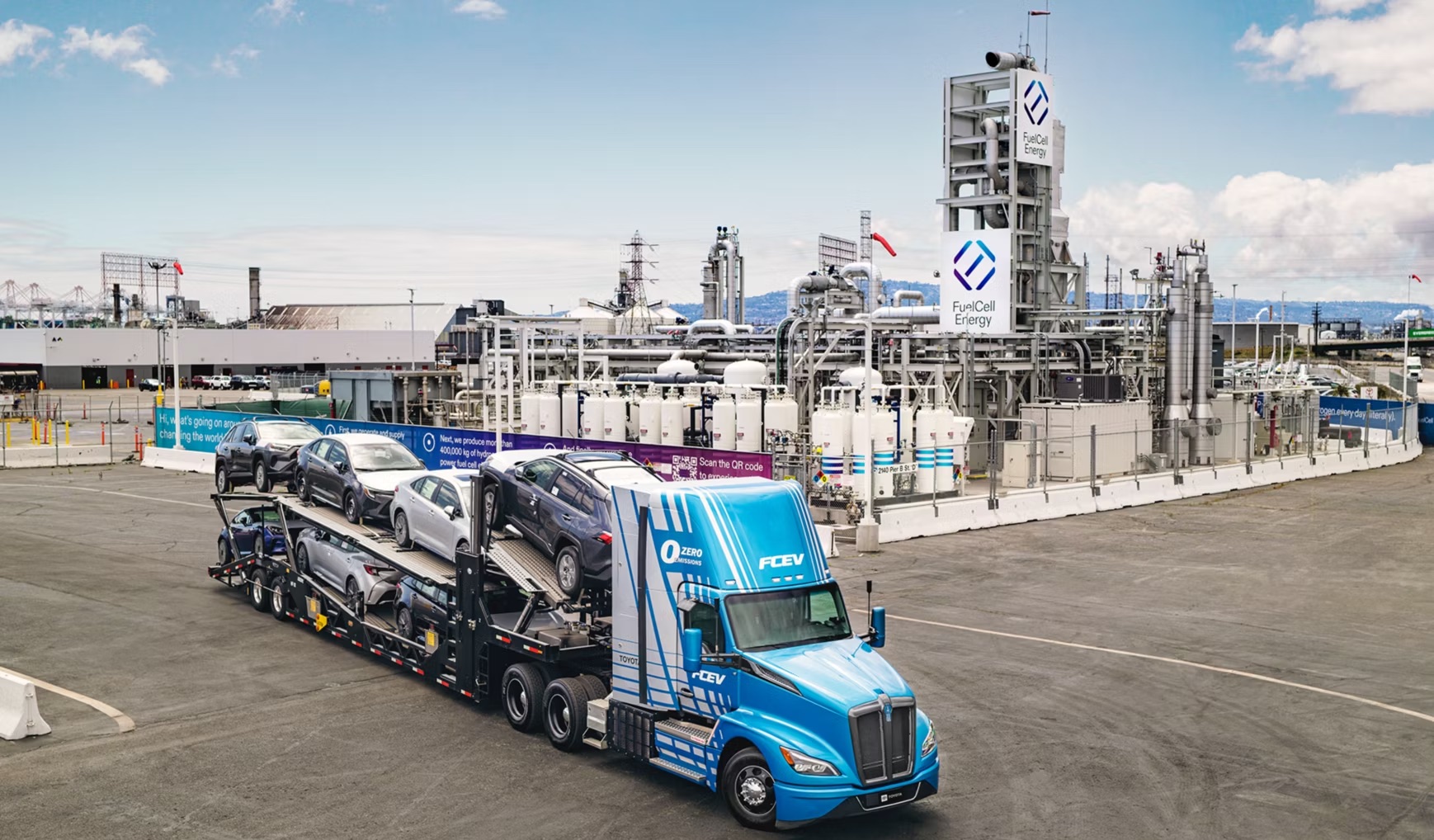
Filling up a hydrogen tank is much like filling up a gas-powered car in both the basic experience and in the time it takes. That’s been a major barrier for EVs thus far; adding 20 minutes or more for each recharge on a road trip is not nearly as appealing as pulling up to a Chevron station and getting out of there in a few minutes. However, hydrogen hasn’t yet caught on as a large-scale solution largely due to funding, even though even the US Department of Energy says it has “several benefits over conventional combustion-based technologies currently used in many power plants and vehicles.”
In December, Toyota announced its intention to amp up US hydrogen infrastructure by investing in FirstElement Fuel, the largest retail hydrogen fueling infrastructure provider in California. The automaker has spent the last 30 years researching and developing hydrogen fuel cells; in fact, Toyota has a full campus in Gardena, California, dedicated just to hydrogen research. While it has been refining hydrogen fuel-cell technologies since 2001, the campus was just renamed the Toyota North American Hydrogen Headquarters (which it calls H2HQ), in 2024.
Toyota debuted the hydrogen-powered Mirai sedan back in 2015, but so far it’s only available in California, the only place in the country where hydrogen pumps are available for passenger cars. At its Arizona proving grounds, Toyota also tests its heavy-duty class 8 hydrogen fuel-cell trucks, racing them against their diesel siblings. I had the chance to ride shotgun in the FCEV and diesel-powered semi on two separate test runs, and the hydrogen truck is vastly cleaner, quicker, and spits water from its tailpipe instead of noxious fumes. However, getting the rest of the country to adopt H2 is a long game.
Toyota has been researching and testing hydrogen-powered vehicles for the last three decades. Image: Nissan
How hydrogen fuel cells work
Bearing the symbol H and atomic number 1, hydrogen is the lightest and most abundant element in the universe. It can be produced via steam methane reformation, electrolysis, and biomass gasification and hydrogen separation. Fuel cells generate electricity through an electrochemical reaction, not combustion, and are used to provide power for homes, businesses, and transportation. They don’t need to be periodically recharged like batteries, just access to a source of more fuel.
A fuel cell is composed of an anode, cathode, and an electrolyte membrane. According to the D.C.-based Fuel Cell & Hydrogen Energy Association, this is how the process works:
Hydrogen atoms enter at the anode while oxygen passes through the cathode.
A catalyst strips atoms of their electrons, separating the protons.
Positively charged protons pass through the porous electrolyte membrane to the cathode, and negatively charged electrons are forced through a circuit, generating electricity.
After passing through the circuit, the electrons combine with the protons and oxygen from the air to generate the fuel cell’s byproducts: water and heat
“I think a lot of folks think it’s a very complex system, but it’s just a battery with an anodic cathode; the chemical reaction happens silently as you add hydrogen to the system,” says Debby Byrne, an executive program manager at Toyota North America. “There’s no moving parts, so you get that benefit as well. You’re not taking it into the dealership for oil changes, and you get less wear and tear compared to a piston-driven engine.”
Oil- and gas-fueled vehicles aren’t a risk-free process either. Gasoline tanks can be dangerous if they’re not made with high-quality materials and processes, and even though the safety measures have come a long way you’ll still see warnings about static electricity on gas pumps across America. Oil is expensive to collect, too, but the infrastructure and support is well established.
Toyota uses the same level of detail and attention to safety when it comes to building its hydrogen fuel-cell vehicles as it does for its gas and hybrid cars, trucks, and SUVs. Plus, hydrogen sensors detect a leak or a collision, Toyota says; in case of an accident, the hydrogen tank valves are designed to close, preventing any additional hydrogen from escaping.
Hydrogen fueling is not widely available yet, but Toyota hopes to change that. Image: Toyota
Convincing the skeptics
Hydrogen is a clean energy that may be produced using solar power, wind, and biowaste. Toyota and Connecticut-based FuelCell Energy launched the first-of-its-kind “Tri-gen” system in 2023, which uses biogas from a nearby wastewater treatment facility to produce renewable electricity, renewable hydrogen, and usable water. These products are used for port vehicle processing operations at Toyota Logistic Services Long Beach. .
Toyota says the use of renewable electricity helps reduce more than 9,000 tons of anticipated CO2 emissions per year, while unused electricity is returned to the local utility. Every day, the Tri-gen facility produces up to 1,200 kilograms of hydrogen daily for fuel-cell electric vehicles, including large class 8 semi trucks, and it recycles about 1,400 gallons of water every day.
That recycled H2O is used to wash vehicles just arriving from the plant in Japan prior to delivery, which reduces water waste from the local plant. Notably, Toyota and FuelCell’s Tri-gen facility was honored with the US Department of Energy’s 2025 Better Project Award in May. The Better Project Award recognizes innovation in energy, water, and waste reduction efficiency.
Toyota sees it as a “game changer” for the world, but it has its fair share of skeptics and naysayers. Toyota hosted me and a select group of journalists for a tour of its 12,000-acre testing ground in Arizona recently, and Caleb Jacobs from The Drive entered a skeptic and emerged enlightened, if not completely convinced about hydrogen power. It became clear, he says, that Toyota views hydrogen as a solution for a future not yet clear to the everyday person.
Toyota’s H2-Overlander concept truck was built to show how H2 emissions could be put to use as a non-potable water source while camping. Image: Toyota
Take Toyota’s H2-Overland concept, unveiled at the SEMA show in November, which collects and filters water produced by the fuel cell. Users can then use that replenishing water supply for non-potable functions like washing hands or dishes.
“Imagine that same idea,” Jacobs says, “but with industrial generators and power supplies.”
The post Toyota is drag racing hydrogen-powered trucks in the Arizona desert appeared first on Popular Science.
