
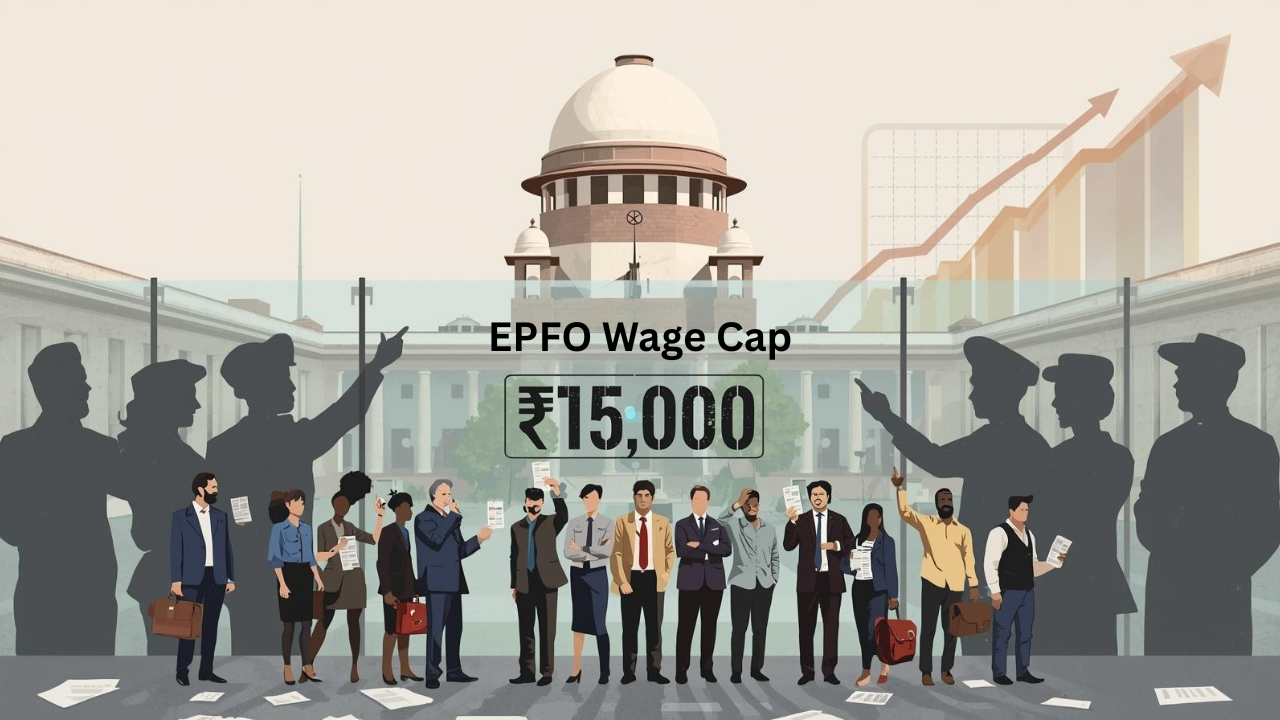
The Supreme Court has nudged the Centre to finally confront a long-pending issue that affects millions of salaried workers, which is the stagnant wage ceiling under the Employees’ Provident Fund Scheme (EPF Scheme). On Monday, the apex court asked the Centre to consider taking a decision within four months on revising the EPFO wage limit, which has remained unchanged for more than a decade.
A Bench comprising Justices J K Maheshwari and A S Chandurkar passed the directions while disposing of a petition filed by social activist Naveen Prakash Nautiyal. The plea highlights how the current ceiling of Rs 15,000 per month excludes a large segment of employees from the social security net administered by the Employees’ Provident Fund Organisation.
Why The EPFO Wage Ceiling Is Under Scrutiny
Appearing for the petitioner, advocates Pranav Sachdeva and Neha Rathi argued that the wage threshold has failed to keep pace with economic realities. According to them, minimum wages notified by both the Centre and several states now exceed the EPFO limit, rendering the existing cap outdated. As a result, many workers are unable to access provident fund benefits despite being part of the organised workforce.
Sachdeva submitted that the prolonged delay in revising the ceiling has diluted the welfare intent of the EPFO framework, which was designed to provide long-term financial security to employees.
Court’s Directions And Next Steps
The court has asked Nautiyal to submit a formal representation to the central government within two weeks, enclosing a copy of the order. The Centre, in turn, has been directed to examine the matter and arrive at a decision within four months, bringing a timeline to an issue that has seen years of inaction.
What The Petition Argues
Nautiyal’s plea invokes Articles 14 and 21 of the Constitution, alleging arbitrary and irregular handling of wage ceiling revisions under the Employees’ Provident Fund Scheme, 1952. It flags the absence of any structured mechanism or linkage to indicators such as inflation, minimum wages or income levels.
“This erratic approach has resulted in the exclusion of large sections of the workforce, contrary to the objective of providing social security to employees in the organised sector. The Public Accounts Committee of the 16th Lok Sabha and the EPFO’s own Sub-Committee (2022) have both recommended periodic and rational revision of the ceiling, but despite approval by the Central Board (EPF) in July 2022, the Central Government has not acted upon these recommendations,” it said.
The plea further underscores inconsistencies in wage ceiling revisions over seven decades.
“A statistical analysis of the revision in the wage ceiling over the last 70 years shows that it has not been consistent with any of the above-mentioned metrics. While the wage ceiling currently continues to remain at Rs 15,000, the minimum wages in several parts of the country are much higher. This has led to reduced coverage of the scheme thereby leading to a failure of the objectives of the Act,” it said.
It also notes a gradual shift in the scheme’s character.
“This is clearly reflected in the significant disparity between the number of workmen covered by the scheme at the time of its inception and the substantially reduced number of workmen covered by the scheme presently,” it added.
Finally, the petition points to pending recommendations from within EPFO itself.
“The said recommendation was approved by the Central Board (EPF) in July 2022. Recommendations of the Central Board (EPF) are pending consideration with the Central government,” it said.
