
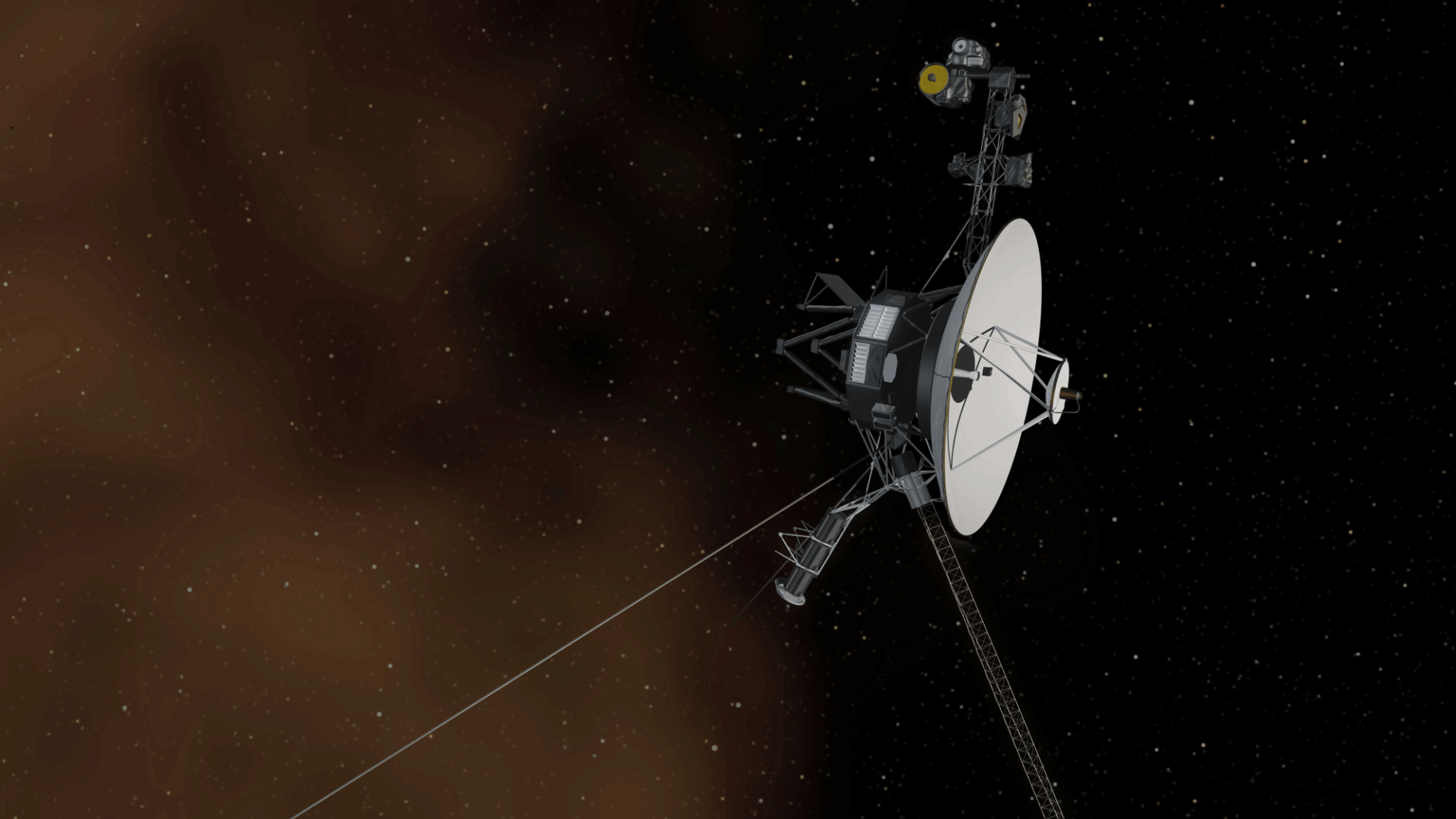
Voyager 1, the NASA space probe that has traveled farther from Earth than any other human-made object, is closing in on a remarkable milestone. Actually, let’s call it a 16.09-billion-milestone. That’s the distance a photon can travel in a single day, which is to say the Voyager 1 spacecraft will be exactly one light-day away from our planet on November 18 at 5:18 a.m. EST.
At that moment, a radio signal sent from Earth would take 24 hours to reach Voyager 1, and then it would take another 24 hours for the probe’s response to come back. Imagine on a Friday morning telling your oven to turn on, but you don’t receive confirmation that it’s hot until Sunday. And by that point, the oven would have been baking whatever was inside for most of Saturday. That is the kind of delay that NASA’s Voyager team must work with.
Communicating with a machine at this superlative distance is “a pretty incredible endeavor,” Princeton University research scientist and heliophysicist Jamie S. Rankin tells Popular Science. Rankin is also a deputy project scientist of the Voyager mission. “In my mind the fun is receiving a signal back from the Voyager, a light-day away.”
Rankin and other astronomers use those signals to study the very local interstellar medium, which is the suburb of space surrounding our solar system. Voyager 1 has been in this region, about 11 billion miles away, since 2012. There, the probe can detect changes in plasma and the magnetic field.
“Right now we’re trying to figure out how far out are the influences of the sun felt,” she says.
This artist’s concept shows the outer layers of our solar bubble, or heliosphere, and nearby interstellar space. NASA’s Voyager 1 is currently exploring a region of interstellar space, which is the space between stars that still feels charged particle and magnetic field influences from the heliosphere. The magnetic field lines (yellow arcs) appear to lie in the same general direction as the magnetic field lines emanating from our Sun. Image: NASA/JPL-Caltech
The sun continuously spits out charged particles in a stream of solar wind that extends into space. That wind pushes back against the gas and other interstellar stuff surrounding our solar system, sculpting a bubble in space known as the heliosphere. “There will be some part farther out, some distance away [where the] interstellar medium has no idea that the heliosphere is even there,” she says. Rankin adds that she thinks Voyager 1 is right on the edge of this “undisturbed, pristine interstellar medium.”
It is something of a marvel that the almost 50-year-old Voyager 1 continues to supply astronomers with data. To send information to Earth, the probe uses a 23-watt radio transmitter (about the output of a small refrigerator lightbulb). Only antennas as sensitive as the 70-meter-wide dishes in the NASA Deep Space Network can detect Voyager 1’s super-faint signal. Without them, the space probe would have gone incommunicado years ago.
When Voyager 1 launched in September 1977, the nuclear-powered spacecraft had 10 operational scientific instruments. It discovered new moons orbiting Jupiter and Saturn on its way out of our solar system; its observations of Jupiter’s moon Europa hinted at a liquid ocean under an icy crust. When the probe traveled beyond our solar system’s planets, NASA’s Voyager team shut down unnecessary equipment to conserve power. Now only two of its instruments are active. Ongoing management continues to preserve as much juice as possible from the spacecraft’s dwindling plutonium supply. The team was also forced to turn off the Low-energy Charged Particles experiment in April. In September, NASA swapped out three systems for lower-power alternatives on the Voyager 1, about six weeks after the same strategy worked on its twin Voyager 2 probe.
This archival photo shows engineers working on vibration acoustics and pyro shock testing of NASA’s Voyager on November 18, 1976. Image: NASA/JPL-Caltech.
“It’s fun to see what sort of innovation people come up with to keep the spacecraft going,” Rankin says. “There’s only so much you can turn off.”
Voyagers 1 and 2 have been operating without several instrument heaters for years. If shutting those off hadn’t worked, Rankin says “the mission would have ended a decade ago.”
Still, its operational margins are thin. In late October, NASA briefly lost contact with Voyager 1; that issue has appeared to resolve itself and may have been related to a group of thrusters going offline.
“This is the first time we’ve seen the spacecraft do something like this, but we are also at a point in the mission where we have to expect the unexpected,” Kareem Badaruddin, Voyager mission manager at NASA’s Jet Propulsion Laboratory (JPL), said in a news release. “We’re relieved to be back in contact with Voyager 1 and are eager to understand what happened.” (JPL representatives did not respond to Popular Science’s requests for comment.)
All spacecraft missions must come to an end, no matter how plucky the probe or innovative its engineering team. NASA estimates that the Deep Space Network will lose contact with Voyager 1 around 2036, long before it travels to its two-light-day milestone. The probe may also freeze, unable to point properly back at Earth. Or its power systems will finally go kaput.
“We know that’s coming at some point. It’s probably not 20 years from now,” Rankin says. “It’s probably not 10 years from now.”
And then Voyager 1 will go forever radio silent as it cruises onward through the heavens.
The post Voyager 1 is almost one light-day away from Earth appeared first on Popular Science.
Voyager 1 is almost one light-day away from Earth
