
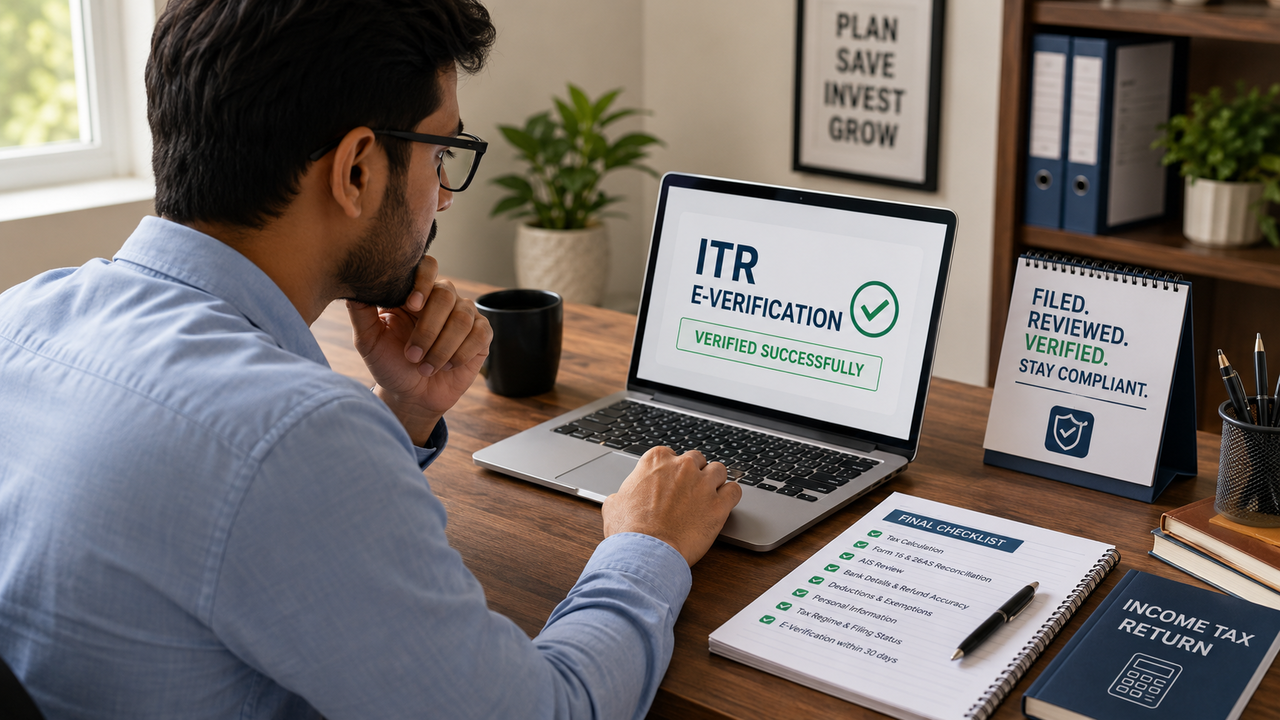
With the income tax filing season underway, many taxpayers are preparing to submit their Income Tax Returns (ITRs) as soon as the filing utilities become available. However, completing the return is only half the task. A return becomes legally valid only after it has been e-verified within 30 days of submission. What many taxpayers overlook is that e-verification works as a confirmation that every detail provided in the return is accurate and complete. Any mistake that slips through at this stage could lead to tax notices, refund delays, or the need to file a revised return later.
If you have already filed your ITR for Assessment Year (AY) 2026-27, it is worth carrying out a final review before clicking the e-verify button.
Before validating your return, take a close look at the tax computation. Ensure that the tax payable or refund amount appears reasonable based on your income and deductions.
You should also verify that all Tax Deducted at Source (TDS) credits reflected by employers, banks, and other deductors have been correctly considered. Any advance tax or self-assessment tax paid during the year should also be visible in the return. Additionally, check whether interest liabilities under Sections 234A, 234B, or 234C, wherever applicable, have been accurately calculated.
Overlooking errors in tax computation is common and often results in the need for subsequent corrections.
Match Your Return With Form 16, Form 26AS And AIS
A final reconciliation of tax documents can help identify discrepancies before verification. Compare the salary income reported in the return with Form 16 and ensure that TDS figures match those available in Form 26AS.
Taxpayers should also review the Annual Information Statement (AIS) to confirm that interest income, dividends, capital gains, and other reportable transactions have been correctly disclosed. This step can be especially important for salaried individuals who may assume that Form 16 captures all taxable income.
Incorrect bank details remain one of the leading causes of delayed tax refunds. Before e-verification, verify the account number, IFSC code, and ensure that the selected bank account has been pre-validated on the income tax portal.
At the same time, revisit all deductions and exemptions claimed on the return. This includes benefits under Section 80C, Section 80D, Section 80CCD(1B), Section 80G, and home loan-related deductions where applicable. Ensure that no deduction has been claimed twice or under an incorrect provision.
Even small errors in personal details can create unnecessary complications later. Taxpayers should confirm that their PAN details, Aadhaar linkage status, name, date of birth, residential status, and contact information are correct.
It is equally important to ensure that the correct tax regime and filing status have been selected before the return is verified.
Why E-Verification Should Not Be Delayed
Failing to e-verify an ITR within 30 days can have significant consequences. In such cases, the return is treated as invalid, effectively as if no return had been filed.
This may lead to delays in receiving refunds, affect eligibility for refund interest, restrict the carry forward of certain losses, and potentially impact tax-related choices available to the taxpayer.
Taxpayers also frequently discover mistakes relating to income reporting, TDS credits, deduction claims, bank account details, or tax regime selection after filing.
When completing verification through Aadhaar OTP, taxpayers should ensure that the mobile number linked to Aadhaar is active and accessible. The OTP should never be shared with any third party. It is also advisable to save the acknowledgement generated after successful e-verification for future reference.
