
Concrete is everywhere, and that’s a problem. Manufacturing the essential material accounts for around eight percent of annual global carbon dioxide emissions, making it one of the single biggest contributors to the climate crisis. Researchers are investigating all types of creative solutions to the issue, often by replacing ingredients with more eco-friendly alternatives.
Recent propositions include adding coffee grounds, bacteria, and even recycled diapers into the mix.But engineers at Purdue University in Indiana think the answer can already be found in the natural world. According to a study recently published in the journal Chemistry of Materials, one solution may be swapping out the cement for shellfish.
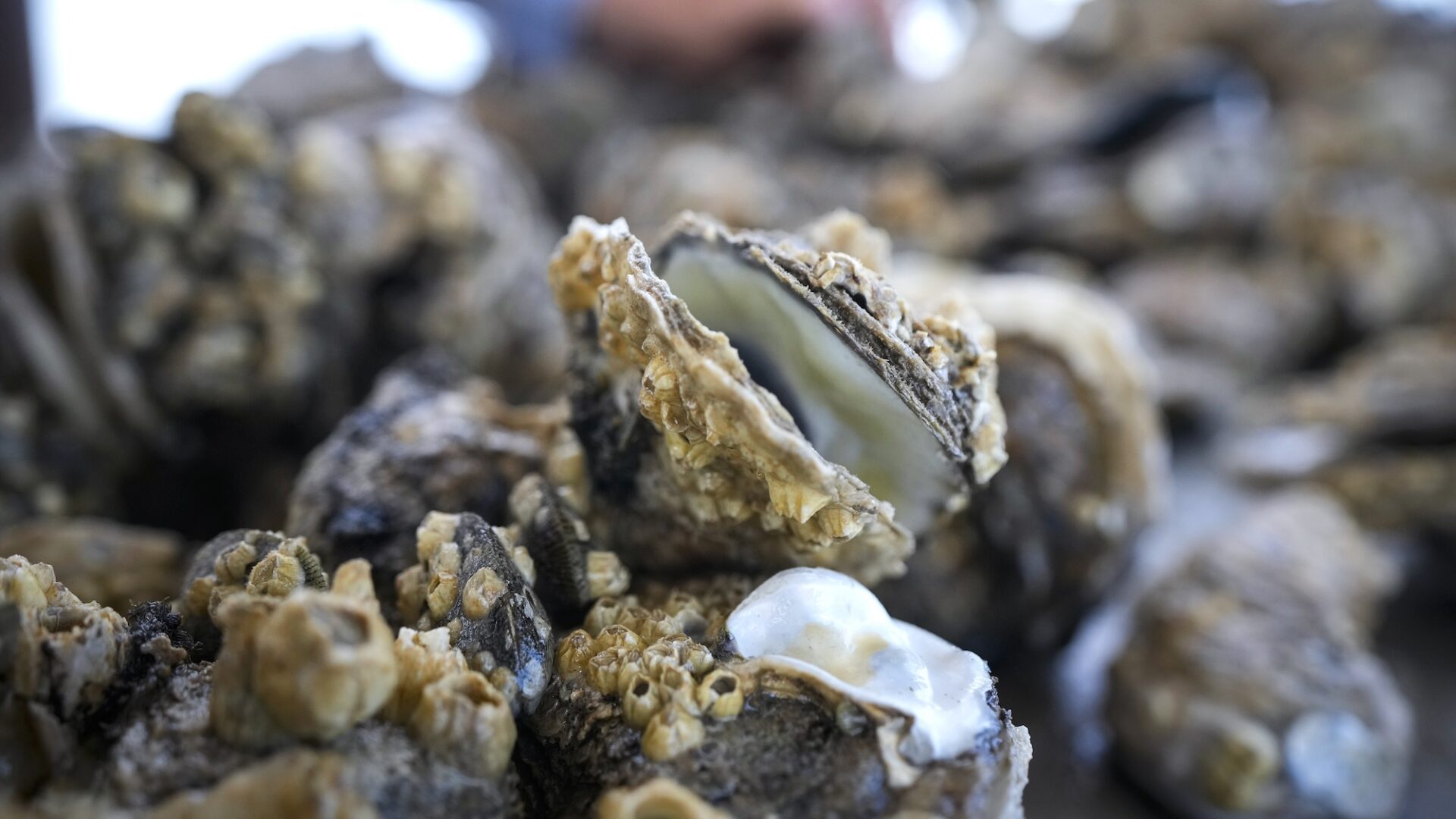
“Oysters generate a natural cement. They use this material for attaching to each other when building reef structures,” chemist and study co-author Jonathan Wilker explained in a recent university profile.
Wilker has spent years examining the biological properties of oyster cement in hopes of recreating the sturdy adhesive for other applications. They have since learned that the bivalves bind together by producing the inorganic compound calcium carbonate—basically chalk. While calcium carbonate isn’t usually adhesive by itself, oysters also produce a small amount of stickier organic materials like phosphorylated proteins. This allows the shellfish to fuse together, even when saturated in water.
After breaking down the chemical composition of oyster cement, Wilker’s team recreated it in a laboratory. They then collected a bunch of limestone bathroom tiles, since their calcium carbonate is virtually identical to oyster shells. From there, they glued stacks of tiles together using their artificial, biomimetic cement. In nearly every stress test, the tiles broke before the bond itself.
Confident in their faux-oyster cement’s abilities, Wilker and colleagues finally tried combining a polymer from their creation into commercially available concrete mix. In lab tests, their oyster-inspired concrete was 10 times stronger while doubling its compressive strength. On top of all that, it also took less time to cure.
Wilker’s team plans to continue testing their patent-pending recipe. He notes that it’s not simply stronger. It’s even more eco-friendly when compared to most adhesives on the market.
“Most of the adhesives that you see at the hardware store are made of organic compounds, derived from petroleum,” he said. “There is so much more that we can learn from nature.
The post Want stronger concrete? Just add oysters. appeared first on Popular Science.
Want stronger concrete? Just add oysters.
