
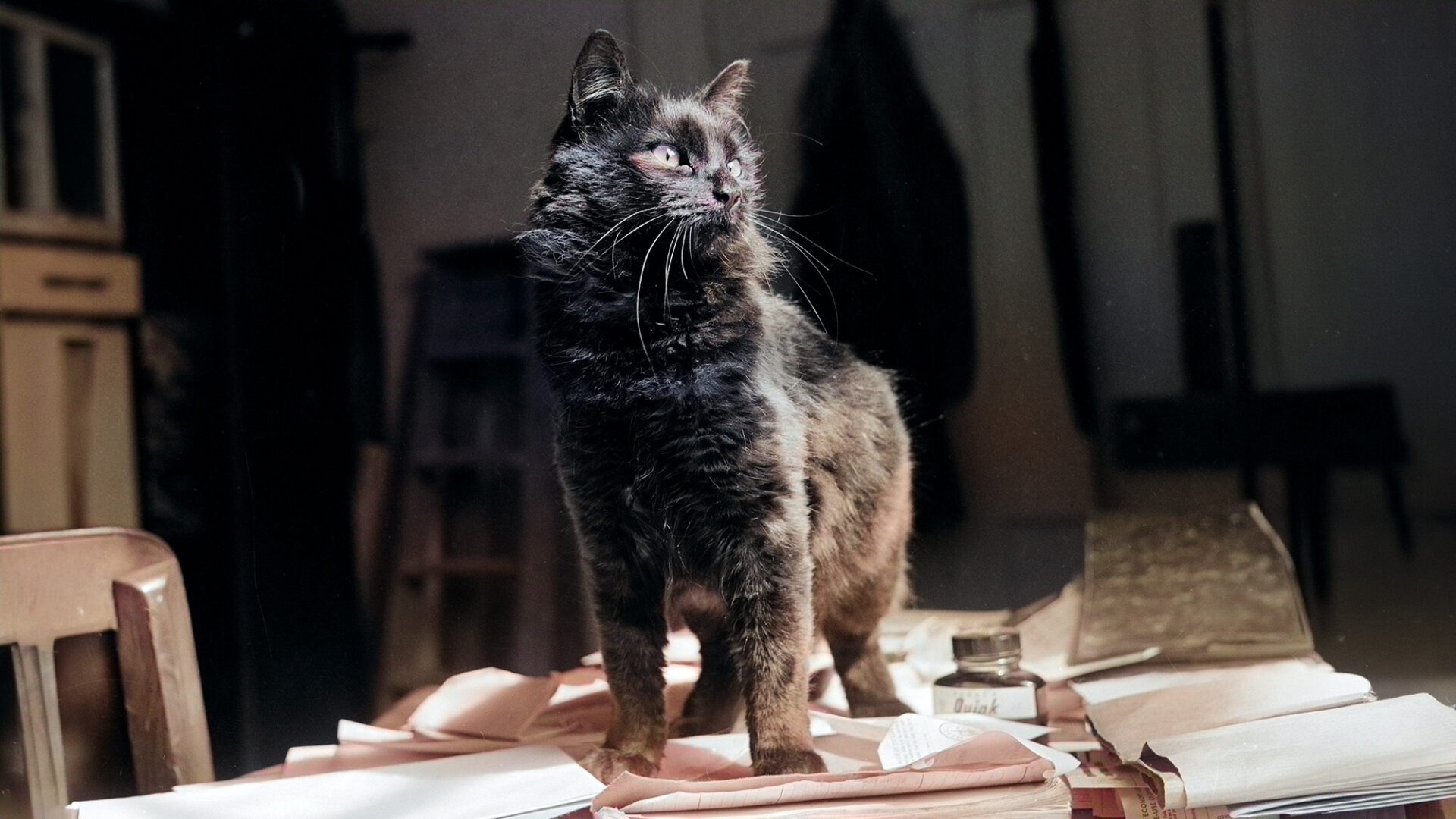
Here’s the scene: A man wearing a trench coat and a fedora sits on a park bench, looking up frequently from his newspaper to cast furtive glances at passersby. A stray cat wanders by. It rubs itself against the man’s legs. He pets it absently and continues to look anxiously at his surroundings.
Eventually, another man arrives, carrying a briefcase. He sits down next to the man with the newspaper. They exchange a few words in Russian, and then the second man departs, leaving the briefcase behind. The first man sits a moment longer, then collects the briefcase and leaves in the opposite direction.
We’ll never know what nefarious plans these two were cooking up…or will we? Could that adorable feline actually have collected any pertinent information?
[dramatic music]
Well, no, that won’t happen. Despite the CIA’s best efforts during the Cold War, using cats as spies became, unsurprisingly, a disaster.
Herding cats for national security
The 1960s were a wild time for the CIA. When they weren’t dosing each other with acid or trying to use exploding cigars to kill Fidel Castro, the Agency’s staff were exploring other novel approaches to espionage, like Project Acoustic Kitty.
The mission was to use that most famously cooperative, obedient and not even slightly contrary of beasts, the domestic cat, to try and collect information from the Soviet Embassy.
Under a huge portrait of Russian dictator Josef Stalin, Washington party-goers gather at a Russian Embassy reception celebrating the Russian Revolution on November 8, 1950. Directly under Stalin’s portrait can be seen the singer, Paul Robeson. Image: Bettmann / Contributor / Getty Images Bettmann
Using animals to spy on the Embassy may or may not have been a viable idea, but the CIA made things awfully difficult for themselves with their choice of animal for the job.
Unsurprisingly, the Acoustic Kitty program was a failure, largely because—in news that will shock cat owners to their collective cores—the cat chosen for the mission refused to do what it was supposed to do.
“We never found an animal we could not train”
It’s unclear exactly what went wrong, largely because of conflicting accounts from the two primary sources about the project. The first of these is former CIA agent Victor Marchetti, who discussed the program in an interview with British documentarian Adam Curtis in the latter’s film You Have Used Me As a Fish Long Enough. The second is animal trainer Bob Bailey, who spoke to the Smithsonian magazine about the program in 2013.
Both Marchetti and Bailey agree on the fact that the cat was basically turned into a walking radio, with a transmitter implanted in its abdomen.
Marchetti claims that on its first mission, the poor cat was hit by a car before it got anywhere near its targets.
Bailey contradicts this, and maintains that despite sounding absurd—and, frankly, cruel—the project wasn’t a complete failure. “We never found an animal we could not train,” he said. “We found that we could condition the cat to listen to voices… we found that the cat would listen to people’s voices more and more, and listen less to other things.” Acoustic Kitty, he maintained, was “a serious project.”
The only other source we have on the project is a CIA document entitled “Views on Trained Cats,” which is accessible—in heavily redacted form—via the National Security Archive at George Washington University.
The document declares that “it is indeed possible…,” but the rest of the sentence is redacted. The next sentence proclaims that the thing that is indeed possible, whatever it may be, is also “a remarkable scientific achievement,” and that “the work done on this problem over the years reflects great credit on the personnel who guided it.” (The personnel are not named.)
Ultimately, though, the document concludes that while “cats can indeed be trained to move short distances,” the whole thing is a dead end: “The program would not lend itself in a practical sense to our highly specialized needs.”
Why are cats so dang hard to train?
Anyone reading about this project could sympathize with cats not caring in the least about our highly specialized needs. But still: why are cats so disinclined to do anything we want? After all, dogs are desperate to please. Why are cats so…difficult?
Stephen Quandt, a professional cat behaviorist based in New York City, tells Popular Science that there’s a key difference between man’s best friend and the humble domestic cat: “Dogs have been bred to want to please us. Retrieving a ball feels good to them, but it also feels good that we’re asking them to retrieve it, and that they’re able to do it.”
Cats, by contrast, don’t particularly care whether what they do makes us happy, so long as it makes them happy: “Cats want to do exactly what they enjoy, without respect to whether we want them to do it or not.”
This may well have something to do with how cats and dogs became domesticated. While there are competing theories about exactly how the domestication of animals played out, cats are widely held to have self-domesticated. They came into contact with humans when they started to hunt the vermin that lived in our granaries, and we let them stick around because killing those vermin was also helpful to us.
Dogs, by contrast, were bred deliberately for a wide variety of purposes, from herding sheep to retrieving birds and helping the blind. Training dogs to handle these jobs requires extensive interaction. Cats, meanwhile, only had one job—killing vermin—and it was something they did with gusto anyway.
Related ‘That Time When’ Stories
The tiny tuxedo cat who became a naval hero
During WWII, a dress-wearing squirrel sold war bonds alongside FDR
BOOM! That time Oregon blew up a whale with dynamite.
Idaho once dropped 76 beavers from airplanes—on purpose
Emus once faced down the Australian army—and won
How to train a cat to become a Cold War spy
With all this in mind, it’s not surprising that the cat chosen for Acoustic Kitty showed very little interest in spying on anyone, Soviet diplomats or otherwise. Thankfully, the days of cloak-and-dagger cat operatives are most likely behind us—these days, it’d be just as easy to use a tiny drone or something. But still, if Quandt had to train a cat to go and eavesdrop on a Soviet spy, how would he go about doing so?
“I would probably try to find a really friendly cat,” he laughs. He explains that ideally, the cat would be familiarized with the people in question. Given that doing so would be impossible in this scenario, he’d fall back on the universal motivator: food. “If the spies were outside, maybe they would sometimes have a picnic. So I would try to make sure the cat was hungry.”
What’s the best way to train a cat?
More generally, though, he says there’s a common method for training cats that act in films, perform in circuses, etc., and it involves a device called a clicker. “If you give a cat a treat right when they do the thing you want them to do, their walnut-sized brain makes the connection and they go, ‘Oh, treat!’”
If you accompany the treat with a sound, the cat begins to associate the sound with the treat. This classic Pavlovian scenario is called “click-and-treat.” As Quandt explains, “The click becomes a predictor of a reward, and eventually it becomes a temporary reward itself. The cat knows the treat is coming.”
Once the cat associates the clicker with a reward, it becomes reasonably straightforward to build an association between that reward and a desired behavior. Scratch the scratching pole instead of the couch? Click. Refrain from attacking your friend while he’s peeing? Click. Surreptitiously retrieve the nuclear codes from the man in a trench coat reading an upside down newspaper? Click.
This is how we end up with cats like internet-favorite Owlkitty, whose appearances in parodies of big-budget feature films are the stuff of YouTube legend. Was it also used in the training of Acoustic Kitty? We’ll never know—and hopefully we’ll never again have any reason to find out.
In That Time When, Popular Science tells the weirdest, surprising, and little-known stories that shaped science, engineering, and innovation.
The post The CIA once trained cats to be Cold War spies appeared first on Popular Science.
